
Practical Guides
Log in to saveWhat Is Marketing? Basic Concepts and Types
11 min read

The shortest answer to the question of what marketing is: it is the process by which businesses and organizations understand the needs and wants of their target audiences, create value for them, communicate and deliver this value, and in return build sustainable, profitable relationships. In other words, advertising is only one part of this; the real decision-making area concerns delivering the right product to the right person, in the right place, and at the right price. In this guide, we address marketing's academic definition, its core concepts, its traditional and digital types, how it works, and which channel you should prioritize in which situation, using practical decision criteria.
Table of Contents
What is marketing? Definition of the decision
According to the classic academic definition, marketing is the entirety of the planning and implementation activities related to developing, pricing, promoting, and distributing goods, services, and ideas in order to manage the exchange process aimed at satisfying people's needs and wants. The widely accepted definition of the American Marketing Association similarly defines marketing as an organizational function and a set of processes for creating value for customers, communicating and delivering this value, and managing customer relationships in ways that benefit the organization and its stakeholders.
From a more business-oriented perspective, marketing is the process of getting people interested in your company's product or service. This process encompasses many aspects of a business, such as market research, analysis, understanding the target customer profile, product development, distribution, and advertising. This is precisely why it is seen as a holistic management activity extending from product development to pricing, and from distribution to communication.
The common point of these definitions is this: marketing is not a one-time announcement, but a continuous decision of value creation and exchange management. Therefore, the success of a campaign is measured not only by how many people it reaches, but by how well it meets a particular need.
Core concepts of marketing
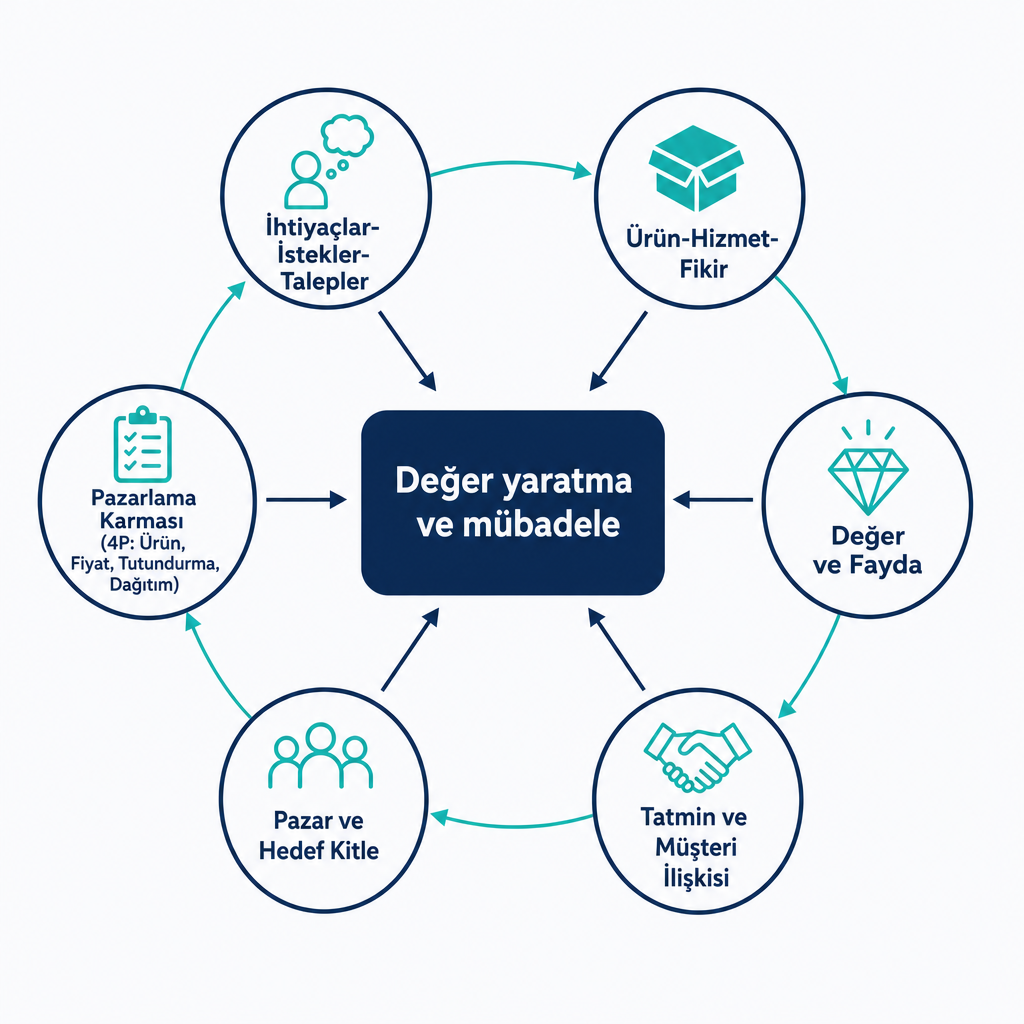
To place marketing on a solid foundation, it is necessary to see how a few key concepts are connected to one another. These concepts are not dictionary definitions, but the logic behind everyday campaign decisions.
- Needs, wants, and demands: People's basic needs (such as security and nutrition) and their wants and demands, shaped by culture and personal preferences, are the starting point of marketing.
- Product, service, and idea: Marketing activities are carried out not only on tangible products, but also on services and even ideas.
- Value and benefit: The customer perceives the benefit they obtain in return for the price they pay as "value"; the central task of marketing is to create value that satisfies needs and wants.
- Satisfaction and customer relationship: When the value offered meets expectations, satisfaction occurs; marketing focuses on the continuity of this satisfaction.
- Exchange: Marketing is the process that enables the exchange of one value (money, time, attention) for another value between two or more parties.
- Market and target audience: The market is the sum of individuals and organizations that share a particular need and are willing and able to pay for a product to meet that need.
- Marketing mix (4P): Product, Price, Promotion/communication, and Place/distribution are the widely accepted core components of the marketing mix.
- Management and strategy: Marketing is a management process that involves planning and implementation in a dynamic environment, and it is not limited only to for-profit businesses.
If you want to compare these terms in more depth in your daily work, our digital marketing terminology dictionary provides the equivalent of each concept with short definitions. With digitalization, these concepts have become more intertwined with online channels, data analytics, and measurable performance targets; but at the core, there is still value creation for the customer and exchange management.
Types of marketing: traditional and digital axis
Understanding the types of marketing is a decisive decision in terms of choosing the right channel and strategy, especially for those dealing with digital marketing and e-commerce in Turkey. Grouping the types along two main axes makes it easier when making a choice: traditional and digital.
Traditional marketing types
Traditional marketing encompasses methods that come from the pre-digital era and still play an important role in many sectors:
- Mass media advertising: Conveying collective messages to broad audiences through channels such as TV, radio, newspapers, and magazines.
- Physical point-of-sale marketing: In-store layout, window displays, promotions, and face-to-face sales activities.
- Public relations and sponsorship: Events, press relations, and sponsorships that strengthen brand image.
- Direct marketing: Traditional channels that establish one-on-one contact, such as mail and telephone.
These types retain their importance especially for businesses that depend on local and physical customer traffic.
Digital marketing types
Digital marketing is defined as the activities of presenting businesses' products and services to potential customers through online channels. It refers to the set of strategies that enable brands to connect with their target audiences through channels such as search engines, social media, email, websites, and mobile applications.
- Search engine marketing (SEM) and SEO: Search engine advertising and organic visibility efforts.
- Social media marketing and advertising: Content and paid campaigns on platforms such as Facebook, Instagram, TikTok, and LinkedIn.
- Content marketing: Producing value-focused content with blog posts, videos, guides, and e-books.
- Email marketing: Regular communication and campaigns through opt-in email lists.
- Display and video advertising: Banner ads, programmatic buying, and video-focused campaigns.
- Influencer marketing: Product and service promotion through influential people and content creators.
Digital marketing offers a lower-cost, measurable approach that can reach the target audience more directly compared to traditional methods; for this reason, it has become indispensable for businesses engaged in e-commerce and performance marketing. For short lists that will be useful when putting these channels into practice, you can check out our practical information section.
How does marketing work? Mechanisms and options
The practical answer to the question of what marketing is becomes stronger by understanding how the process works. The mechanism is fundamentally shaped around a chain of logic in which each step feeds the next:
- Understanding the market and target audience: Identifying people's needs, wants, and behaviors through market research, data analysis, and segmentation.
- Value proposition and positioning: Determining the unique benefit that distinguishes your product from competitors and clarifying how you will position it in the market.
- Designing the marketing mix: Aligning the product, price, distribution channel, and communication strategy according to the target audience.
- Communication and promotion: Delivering messages consistently and regularly through advertising, content, social media, and email.
- Measurement and optimization: Measuring, analyzing, and improving results such as traffic, conversion, sales, and brand awareness, and refining campaigns accordingly.
In digital marketing, these mechanisms are mostly carried out in a data-driven manner; campaigns are adjusted according to real-time performance data, and the contribution of different channels is continuously tested. You can use our free digital marketing tools to support this cycle during the measurement and analysis stage. The main difference here is that, in contrast to traditional approaches whose results are often seen at the end of a campaign, in digital, decisions can be made while the campaign is still running.
Which type of marketing should you focus on and when?
The target audience, business model, and resources determine how the answer you give to the question of what marketing is translates into a strategy in practice. The table below summarizes which channel stands out in which situation, especially for those dealing with digital marketing, e-commerce, and SEO in Turkey.
| Decision criterion | Prominent approach | Why |
|---|---|---|
| Small business with a limited budget | Search ads, social media ads, SEO | Measurable and targetable, low initial cost |
| E-commerce sales model | SEM, social advertising, remarketing, conversion optimization | Focused on direct sales and repeat visits |
| Young, mobile-heavy audience | Social media and mobile-focused channels | Being where the audience spends its time |
| B2B segment | Content marketing, SEO, LinkedIn | Trust and information in long decision cycles |
| Long-term brand goal | Content, PR, creative campaigns | Brand value accumulates differently from short-term sales |
When reading these criteria, don't look for a single correct answer. Measurability and data access generally provide an advantage in favor of digital channels; regular tracking of KPIs makes it possible to see which channel contributes more. The question of whether your priority is brand or performance, on the other hand, directly affects your budget allocation: those targeting direct sales prioritize performance channels, while those seeking long-term value prioritize content and PR.
Most importantly, when making these decisions, it is essential to view marketing not as a one-time campaign, but as a continuously tested and optimized learning process. Your initial choice does not have to remain fixed; as performance data accumulates, you shift your emphasis to the channel that contributes the most.
Legal framework and risks in marketing
When conducting marketing activities in Turkey, complying with the "commercial electronic message" regulations under the Personal Data Protection Law (KVKK) and the Law on the Regulation of Electronic Commerce becomes necessary both strategically and legally. This issue is a part of campaign design that is as important as performance.
A commercial electronic message refers to data, audio, and visual content messages sent for commercial purposes in the electronic environment using means such as telephone, call centers, SMS, and email. Any kind of commercial communication carried out through electronic communication tools to promote goods and services or to increase the recognition of the business is considered within this scope. In order for these messages to be sent legally, explicit consent must be obtained from the recipients in advance, and this consent must comply with the explicit consent requirements of the KVKK.
In addition, through the Commercial Electronic Message Management System (İYS), where commercial electronic message consents are managed centrally, the consents belonging to recipients' contact addresses can be viewed and edited; businesses are obligated to integrate their sending processes into this system. Acting in violation of the KVKK and the commercial electronic message regulations is a significant risk that could lead to administrative fines and reputational loss due to the unlawful processing of personal data and unauthorized message sending.
Since the application of these regulations may vary depending on the business's situation, it is advisable to rely on current official sources and, when necessary, legal counsel for critical decisions. In marketing design, not only performance and sales but also legal compliance and customer trust should be considered as a fundamental decision criterion.
Digigund perspective: combining learning and practice
For those who want to learn in the fields of digital marketing, e-commerce, and measurement/analytics in Turkey, the question of what marketing is usually gains meaning through practical examples and applicable guides. As Digigund, we aim to make this learning process systematic by offering dictionary content that explains digital marketing terms, practical KPI and tip guides, current industry news, and free tools all in one place.
Basic concepts and an introduction to digital channels for beginners, increasing the e-commerce conversion rate and ad optimization for e-commerce store owners, and measurement, analysis, and channel-based guides for those working in SEO and performance marketing all support marketing decisions with concrete examples. If you want to follow the latest developments in the industry, our digital marketing agenda is updated regularly. In this way, the theoretical definition of marketing turns into a skill set connected to daily campaign management, budget allocation, and KPI tracking.
Frequently asked questions
What is the difference between marketing and sales?
Sales refers to the transactions related to the actual sale of a product or service to the customer and the generation of revenue. Marketing, on the other hand, is the broader management process that plans the market, customer, product, price, distribution, and communication in order for this sale to take place.
Has digital marketing completely replaced traditional marketing?
Digital marketing has become the main medium in many sectors by offering a more targetable and measurable structure through online channels. However, traditional channels such as TV, outdoor, and physical points of sale still play an important role in many marketing mixes.
Where should a small e-commerce business start with marketing?
For e-commerce businesses with limited budgets, search engine ads, social media ads, basic SEO, and conversion optimization are usually the starting points that provide the fastest return. The performance of these channels should be measured regularly, and the strategy should be gradually expanded.
How is a marketing budget determined?
The budget is usually determined by taking into account the revenue target, profit margin, level of competition in the sector, and the cost of the chosen channels. In digital marketing, dynamically adjusting the budget with campaign- and channel-based performance data is a common approach.
What should I pay attention to in terms of KVKK when doing marketing?
Building opt-in communication lists, obtaining explicit consent in advance for commercial electronic messages, managing İYS registrations and permissions, processing and storing personal data in compliance with the KVKK, and also providing recipients with an easy opt-out option are the fundamental compliance steps.