
Practical Guides
Log in to saveWhat Is Marketing? Basic Concepts and Examples
11 min read

The shortest answer to the question of what marketing is: it is the planning and implementation of the decision to offer the right value, to the right person, at the right time, and through the right channel. In other words, it is a management activity that creates value for both the customer and the business while bringing a product or service together with the target audience, extending from before the sale to after it. Equating marketing solely with advertising or sales is a common misconception; in reality, marketing is a broad decision-making area that encompasses the development, pricing, distribution, and promotion of products and ideas together.
In this guide, we clarify the definition of marketing, how it works, its core concepts (4P and 7P), its counterpart in the digital environment, and the points you should consider when making decisions for your own business or career. Our goal is to explain the concepts in plain language and support them with practical examples; this way, you can place marketing within both a theoretical and applicable framework.
Table of Contents
What is marketing? Definition and the decision to make
According to academic and professional sources, marketing is a process of planning and implementation that encompasses the development, pricing, distribution, and promotion of products, services, and ideas. The American Marketing Association defines marketing as the set of institutions and processes involved in creating, communicating, delivering, and exchanging offerings that have value for customers, partners, and society. The critical point of this definition is: marketing begins before a product is produced and continues even after the product is sold.
In practice, the question "what is marketing?" actually refers to a chain of decisions. As a business, you decide which target audience you will offer which value to, through which channels and messages. You determine whether you will prioritize short-term sales or long-term brand value. And you choose which metrics (KPIs) you will use to measure and improve the process.
This decision stands at the center of marketing with both its strategic and operational dimensions. On the strategic side, there is brand positioning and target market selection; on the operational side, there are campaign, budget, and channel decisions. When these two layers do not work consistently, marketing efforts fall apart. As we explain digital marketing with plain definitions in our digital marketing terminology glossary, it should be approached as an electronic and internet-based, multi-channel, and measurable structure; in other words, marketing decisions are now largely made based on data.
The working mechanism of marketing: value, exchange, customer focus
To understand how marketing works, it is enough to look at three concepts. These three concepts underlie every marketing decision, independent of campaign techniques.
Value is the customer's evaluation of the experience, benefit, and emotional satisfaction they receive in return for the price they pay. Marketing's job is to increase and clarify this perceived value. The answer to the question of why a customer should choose your product is your value proposition.
Exchange is facilitating the "payment in return for value" transaction between the customer and the business. The payment here does not always have to be money; an email address given in exchange for content, loyalty points, or shared data is also a form of exchange. Marketing aims to make this exchange satisfying for both parties.
Customer focus is the backbone of modern marketing. Instead of a producer-focused view, needs and expectations are researched, divided into segments, and personalized offers are presented accordingly. Without knowing to whom, what, and in what context you offer, it is not possible to build a value proposition.
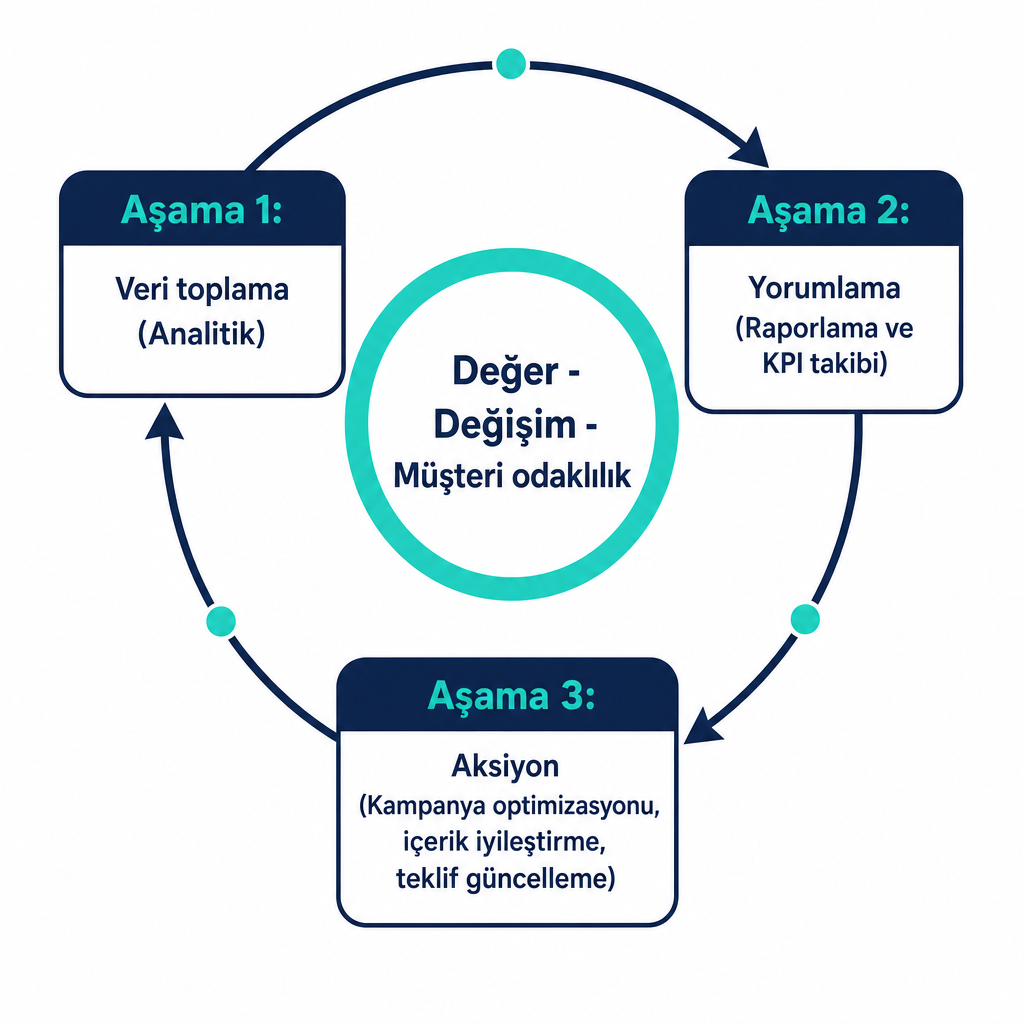
In the digital environment, this mechanism operates as a cycle: data collection (analytics), interpretation (reporting and KPI tracking), and action (campaign optimization, content improvement, offer updating). For beginner-level readers who want to grasp this cycle and choose the right metrics, in our short and applicable practical guides we summarize topics such as which metric to look at and which mistakes to avoid.
Core concepts: the 4P and 7P marketing mix
The marketing mix is one of the most fundamental frameworks businesses use to structure their marketing decisions. The classic approach talks about the 4P; in service-heavy business models, the 7P comes into play. This framework reduces the abstract "what is marketing?" question into concrete decision headings.
The 4P consists of four areas:
- Product: The features, advantages, the problem it solves, and the unique selling proposition (USP) of the product or service you offer. In e-commerce stores, product descriptions, images, packages, and warranties fall under this heading.
- Price: The fee determined according to positioning, costs, competition, and perceived value. Strategies such as cost-plus pricing, value-based pricing, or competitor-focused pricing can be used.
- Place: The channel and distribution model through which the product reaches the customer. A physical store, e-commerce site, marketplaces, mobile apps, or B2B sales teams are different "place" decisions.
- Promotion: The advertising, public relations, campaigns, content marketing, and sales activities used to introduce the product to the target audience. Google Ads, social media ads, email campaigns, and SEO are digital tactics that fall under this heading.
These four areas determine a business's daily answer to the "what is marketing?" question. If your product, price, distribution, and communication are not consistent with each other, your marketing decision remains weak. Offering a product you position as "premium" with cheap packaging and a rock-bottom price is exactly an example of this inconsistency.
In service-heavy sectors, three elements are added to the 4P, forming the 7P. People are the employees, customer service, and sales representatives who represent the brand. Process is the delivery of the service, the order and delivery flow, return policies, and support mechanisms. Physical Evidence refers to all the tangible traces that affect brand perception: website design, packaging, user interface, reviews, and ratings. Especially in digital products, the user interface, support experience, and trust elements (SSL, reviews, return guarantee) become an inseparable part of marketing.
What is marketing in the context of digital marketing?
Digital marketing is the multi-channel and measurable version of the marketing process carried out over the internet and technology. It expands the classic definition: now not only "what you say" but also "where, to whom, on which device, at which moment, and with which sequence of messages you say it" becomes critical. As a result, marketing transforms into an interdisciplinary activity intertwined with data management, user experience (UX), and automation systems.
For beginners, it is useful to approach digital marketing along a few axes. With SEO, you become visible in search engines. With Google Ads and performance ads, you obtain traffic and sales. With e-commerce and conversion optimization, you convert incoming traffic into customers. With measurement and analytics, you base your decisions on data by tracking KPIs.
Although these axes seem like separate tactics, they are the digital counterparts of the same marketing logic: offering value, facilitating exchange, and behaving in a customer-focused way. The channel changes, but the basic mechanism remains the same. For those who want to follow current developments and platform changes in the industry, we regularly compile the digital marketing agenda in our news section; since channel behaviors change rapidly, staying up to date is part of marketing decisions.
Decision points when defining your marketing approach
Answering the "what is marketing?" question for your own business or career requires gaining clarity on a few decisions. These decisions are not a sequential recipe but choices that feed into each other.
| Decision point | The question you need to answer | Why it matters |
|---|---|---|
| Goal | Awareness, customer acquisition, retention, or short-term sales? | The goal determines your budget and channel priority |
| Target audience | Who; with which behavior, interest, and purchase motivation? | The clearer the segment, the sharper the decision |
| Positioning | In what way are you different from competitors? | It defines your "place" in the customer's mind |
| Channel mix | SEO, paid ads, social media, email; where is the emphasis? | It provides efficiency according to sector, audience, and budget |
| Measurement and KPI | By which metric will you define success? | It is your only basis for optimization and decisions |
On the measurement side, metrics such as conversion rate, click-through rate, cart abandonment rate, customer lifetime value (LTV), and return rate stand out. Choosing which metric serves your goal saves you from managing marketing by intuition. We address short summaries of which metrics you should look at at decision points such as conversion and cart abandonment, with concrete recommendations, in our guide on methods to reduce cart abandonment.
Risks and common mistakes
When marketing is set up incorrectly, it creates serious risks both financially and in terms of brand reputation. The most commonly encountered pitfalls can be grouped under a few headings.
Wrong targeting is one of the most expensive mistakes: campaigns are shown to the wrong audiences, the budget erodes rapidly, but quality traffic or sales do not come. Overly aggressive promotion is communication that constantly applies sales pressure without offering value; it creates a spam perception and erodes brand trust. Lack of measurement is managing campaigns by intuition and being unable to know which channel really works; in this case, the necessary optimizations cannot be made either.
Getting stuck in the short term is communicating based solely on discounts and campaigns, relegating long-term brand value and customer loyalty to the background. Incompatible 4P is when product, price, place, and promotion decisions contradict each other; this internal contradiction renders even a good campaign ineffective.
In digital marketing, there is an additional risk: not complying with data privacy and permission-based communication rules. Topics such as GDPR/KVKK and commercial electronic message regulations are decisive both legally and in terms of trust; for conditions and exceptions, you should rely on official sources specific to your own situation and, when necessary, expert opinion. For this reason, marketing includes not only creativity but also the disciplines of risk management and compliance.
A practical example from Turkey: a small e-commerce brand
To make abstract concepts concrete, let's consider a newly established e-commerce brand in Turkey. Let this brand sell custom-designed coffee mugs; the example is entirely for illustrative purposes.
On the Product side, there are different collections and mugs packaged with each collection's own story. For the Price decision, competing marketplaces are examined and a level that suits the perceived quality, both profitable and accessible, is determined. The Place decision is a combination where its own e-commerce site and marketplaces are used together; traffic flows largely from social media. On the Promotion side, SEO-friendly blog content, organic posts on social media, search campaigns, and remarketing focused on reducing cart abandonment work together.
For this business, the marketing decision ultimately comes down to a single question: which message, which creative, to which target audience segment, and on which channel will I show it? Producing an answer to this question with new data every day is the practical face of marketing. For those who want to place the concepts within the context of career or business goals, our marketing training guide for beginners offers both a theoretical and practical framework; this way, you can form a clear answer to the "what is marketing?" question in your own context.
After understanding the core concepts, to move forward, reinforcing the terms from the glossary, learning metric selection with practical guides, and running small-scale experiments with free tools is a healthy sequence. Learning marketing by doing is more lasting than learning by reading.
Frequently Asked Questions
Is marketing only advertising?
No. Advertising is a part of the promotion heading in the marketing mix. Marketing is a broader process in which product design, pricing, distribution, and communication are managed together.
Which is more important, marketing or sales?
Sales is a result of marketing. Without a solid marketing strategy, sales efforts remain short-term and unsustainable; therefore, marketing and sales should be planned together.
What is the fundamental difference between digital marketing and classic marketing?
Digital marketing is carried out over the internet and technology; it has a multi-channel, real-time, and measurable structure. Classic marketing, on the other hand, works more through physical channels and traditional media.
Where should a beginner start learning marketing?
Learning the core concepts first (marketing definitions, 4P/7P, target audience, positioning), then moving on to digital channels (SEO, advertising, analytics) is the right sequence. Our glossary and practical guides are designed for this journey.
Which metrics should be looked at to measure marketing success?
Depending on your goal, metrics such as conversion rate, click-through rate, cart abandonment rate, customer acquisition cost (CAC), repeat purchase rate, and return rate can be used.