Practical Guides
Log in to saveWhat Is Marketing? A Basic Guide for Beginners
10 min read

The most practical answer to the question of what marketing is: marketing is the process of developing, pricing, promoting, and delivering—through the right channels—products, services, and ideas that provide value to your target audience by understanding their needs and wants. In other words, advertising or sharing content on social media is not marketing on its own; these are merely the visible parts of the process. For a beginner, marketing means gaining the perspective of creating value from start to finish and growing that value sustainably. In this guide, we clarify the concept through authoritative definitions and explain the marketing mix, how it works, and what it means for you in an understandable way.
Table of Contents
What is marketing? A simple explanation through authoritative definitions
In expert literature, marketing is not seen as limited to "selling products" or "advertising." According to Philip Kotler, one of the leading figures in the field, marketing is the process by which firms determine which goods or services will attract their customers' interest and develop sales, communication, and business management strategies accordingly. The American Marketing Association (AMA), on the other hand, defines marketing as the process of planning and executing the development, pricing, promotion, and distribution of goods, services, and ideas that enable businesses and individuals to reach their goals.
When we simplify these two definitions, a clear framework emerges. Marketing is a process of "designing and delivering value": it starts with customer needs, continues with product and communication strategies, and renews itself by measuring results. For this reason, marketing is not merely a matter of sales techniques or social media posts. It is an umbrella discipline that encompasses a company's product development, pricing, channel, communication, and customer experience decisions together.
This distinction matters in practice. Because no matter how large a business's advertising budget is, if the product is not designed correctly, if its price does not suit its target audience, or if the sales channel is wrong, the outcome is usually disappointment. Marketing is the mental framework that connects these decisions to one another.
The foundation of marketing: The marketing mix (4Ps and 7Ps)
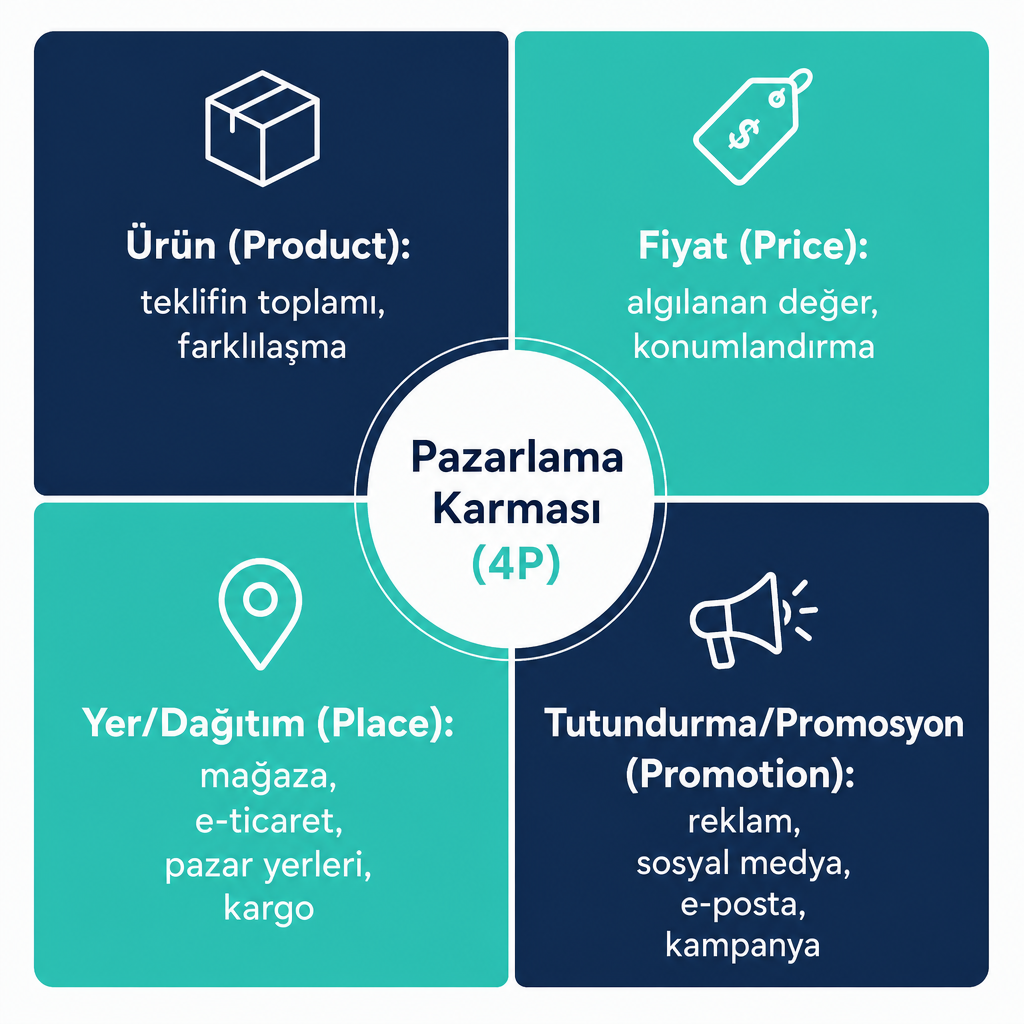
The most classic way to understand marketing in practice is the "marketing mix" or "4Ps of marketing" model. This framework enables a business to systematically think about the fundamental marketing tools at its disposal. The four fundamental elements are:
- Product: This is the physical product, digital product, or service you offer to the customer. The critical question here is: what problem am I solving, and what sets me apart from competitors? For an e-commerce store, the product is not just the t-shirt being sold; it is the sum of the entire offer including size options, return policies, packaging, and visuals.
- Price: This is the amount the customer is willing to pay for that value. It is not just about adding profit to the cost; it is considered together with positioning, competition, perceived value, and the income level of the target audience. The same t-shirt can be marketed at a low price as "fast fashion" or at a higher price as "premium local design."
- Place / Distribution: This refers to where and how the product is offered to the customer. Physical stores, e-commerce sites, marketplaces, mobile applications, and shipping options fall under this heading. A boutique that only sells through Instagram and a brand that has spread to its own site and marketplaces use different place strategies.
- Promotion: These are all the communication activities you use to convey the existence and value of your product to your target audience. Advertising, social media, email marketing, influencer collaborations, and campaigns fall under this heading. A Google Ads campaign, Instagram ads, SEO content, and an email newsletter together form the promotion mix.
When you want to compare deeper terms, the digital marketing terms glossary explains the concepts under these four headings one by one.
From 4Ps to 7Ps: Services and the digital age
Especially in service and digital business models, three more elements are added to the classic 4Ps model, and the model is referred to as "7Ps": People, Process, and Physical Evidence. These additional elements emphasize service quality, the team in contact with the customer, the speed of processes, and the importance of trust-building evidence (reviews, references, interface quality). For a business selling software services or consulting, the customer's decision is often shaped by these three elements.
What marketing is not
To clear up the confusion in beginners' minds, it is useful to clarify the boundaries. Equating marketing with a single tool leads to wasted budget and effort.
Marketing is not just advertising. Advertising is part of the promotion pillar within the marketing mix. Without product, price, and distribution decisions, advertising alone does not produce results. Nor is marketing just social media management; social media is only one of the communication channels, and its impact remains limited without target audience analysis, offer design, and measurement. Finally, marketing is not an activity limited to a "campaign period." It is a continuous process that covers every point of the customer journey (first contact, purchase, repurchase, and recommendation).
This perspective is especially critical for those doing digital marketing. Every effort made with Google Ads, SEO, or email only produces real value when it fits into the overall marketing strategy.
How does marketing work? The mechanism from need to value
There is a simple but powerful mechanism behind marketing. This mechanism works like a cycle and improves itself with each round.
The first step is understanding the need and the target audience. You need to research what problem people are experiencing, what they expect, and which solutions they are open to; market research, user feedback, and search term analysis come into play at this stage. The second step is positioning and offer design: a clear answer is given to the question "Whom are we serving, what are we offering, and why should they buy from us?"; based on this answer, product features, price level, and differentiating factors are determined.
In the third step, the marketing mix is created. Product, price, distribution channels, and the promotion plan are designed to support one another; in service businesses, this structure is strengthened with the team, process, and evidence. The fourth step is execution and measurement: listings go live, content is produced, campaigns are run, and results are monitored with metrics such as conversion rate, acquisition cost, and revenue per customer. The final step is feedback and improvement; which channels are working, which messages are effective, and which segments are more valuable are analyzed, and the lessons learned are fed back into the product, price, and communication strategy.
Digital marketing accelerates this mechanism. Data comes in faster, testing (A/B tests, different creatives) is cheaper, and measurement is clearer. However, the fundamental logic of marketing does not change. For a practical start on choosing the right metric, practical guides explaining which metric to look at will guide you.
Decision: Why and how much should you learn marketing?
While seeking an answer to the question "What is marketing?", you are actually making the following decision: how central will I make marketing in my career, my business, or my store? The response to this decision plays out differently across different profiles.
For those new to digital marketing and for students, understanding the fundamental concepts provides a great advantage when deciding which field—SEO, performance advertising, content, or analytics—to pursue. For e-commerce store owners, the matter is not just about using an ad panel; establishing a balance of product, price, and channel is necessary for profitable and sustainable growth. And for those working in SEO and performance-focused roles, being able to read the whole business rather than being an expert in a single channel visibly increases career opportunities.
When making a decision, you can ask yourself a few questions: Am I willing to learn to read customer needs and data? Does being someone who thinks about business goals, not just someone who sets up campaigns, appeal to me? Do I have a goal of a career or business growth in digital marketing in the medium to long term? If you answer "yes" to these questions, learning the fundamentals of marketing is an investment for you.
Risks and common mistakes
The problems beginners most frequently encounter in marketing are similar to one another and often stem from the same root cause: focusing on a single part without seeing the whole.
| Common mistake | Why it is risky |
|---|---|
| Focusing only on advertising | If the product, price, and offer are weak, increasing the budget usually just enlarges the loss |
| Communicating without defining the target audience | The "anyone can be a customer" approach blurs the message and raises costs |
| Making decisions without tracking data | Managing campaigns by gut feeling leads to wasted budget and missed opportunities |
| Short-term campaign mentality | Discount dependency can pull down brand value; sustainable positioning is needed |
The common solution to these mistakes is to understand the fundamental logic of marketing and its metrics. If product, price, channel, and message support one another, the advertising budget works far more efficiently; otherwise, every campaign turns into an expensive guess.
Getting started with marketing systematically with Digigund
At Digigund, we offer a learning and community space that aims to make your entry into marketing and digital marketing easier by gathering Turkish and beginner-friendly content in one place. On the platform, fundamental concept explanations in glossary format, practical KPIs and tips, up-to-date industry news, and free tools are all brought together.
You can structure your marketing learning journey in several layers. To solidify the terminology, you can read the marketing and digital marketing terms in the glossary section; you can progress with short but practically oriented content on topics such as metrics, campaign mistakes, and channel selection. With free digital marketing tools you can simplify your campaign, SEO, content, and measurement processes; by following the current digital marketing agenda you can reinforce what you have learned through up-to-date examples.
On top of this foundation, if you want to establish a clearer connection between marketing and strategy, the beginner's guide addressing the question of what digital marketing is becomes the next logical stop.
Frequently Asked Questions
Are marketing and digital marketing the same thing?
No. Marketing is the umbrella concept that encompasses all strategic decisions such as product development, price, distribution, and communication. Digital marketing, on the other hand, is the application of this approach through digital channels such as search, social media, email, and advertising networks.
Does marketing necessarily require a large budget?
No. The essence of marketing is understanding the target audience well and creating a valuable offer. Correct targeting and the right message can produce results even with small budgets, especially in the digital space.
Can't I do digital advertising without knowing the 4Ps model?
Technically you can, but ads run without knowing the logic of the 4Ps usually turn into expensive tests. If product, price, channel, and message are not aligned, performance campaigns will not be sustainable.
Where should I start learning marketing?
The healthiest approach is to first learn the fundamental concepts such as "what is marketing" and "what are the 4Ps of marketing," and then focus on a subfield such as Google Ads, SEO, or analytics according to your goals.
Is marketing only for those who study business?
No. The marketing way of thinking is a critical skill for those who start their own business, do e-commerce, content creators, and anyone who wants to develop their career in the digital field.