
Practical Guides
Log in to saveWhat Is Marketing? A Guide for Beginners
10 min read

The shortest answer to the question of what marketing is: it is a strategic and measurable business management process that aims to deliver the right value proposition to the right person, at the right time, and through the right channel. Advertising or launching a campaign is only the visible part of it. Marketing itself encompasses the process of understanding people's needs and desires and, based on that, designing, pricing, promoting, and delivering products, services, or ideas that offer them value through the right channels. For a beginner, the healthiest way to view marketing is as "a systematic value exchange established with the customer" and a strategic way of thinking that designs this exchange.
Table of Contents
What Is Marketing? Basic Definition and Purpose
According to the frequently cited definition of the American Marketing Association, marketing is the process of planning and executing the development, pricing, promotion, and distribution of goods, services, and ideas. This process aims to create an "exchange" that enables the achievement of individual and organizational goals; in other words, a meaningful value exchange is established for both the customer and the business.
The Turkish Language Association describes marketing as the whole set of activities such as promotion, packaging, and identifying and meeting market requirements in order to develop the sale of a product or service. In modern interpretations, marketing stands out as the activity of creating, communicating, delivering, and managing the exchange of offerings that have value for customers, partners, and society.
The common point of these definitions is this: marketing does not begin with the sale; it begins with understanding the customer before the sale and continues with the customer relationship after the sale. Those who want to examine the terms individually to clarify the framework of the concept can take a look at our digital marketing terms glossary.
In short, marketing is the discipline that designs the entire journey of an offering, from the idea stage to the customer relationship.
Marketing Decisions: What, To Whom, and How?
Marketing is, in fact, a decision process made up of consistent answers to three critical questions. To whom am I offering value—that is, who is the target market and target audience? What kind of value am I offering—that is, what benefit does the product, service, or idea provide? How do I deliver and communicate this value—that is, through which channels, price, message, and experience?
In the classic marketing approach, these decisions are systematically planned through the elements of product, price, place (distribution), and promotion. When these four elements come together, they form the marketing mix (4P). What matters is that these decisions begin before the product is sold and continue after the sale with customer experience, loyalty, and feedback.
The point beginners should keep in mind is this: marketing is not just about advertising or launching campaigns. It is the umbrella process that designs the business model, the offering, and the entire relationship established with the customer. That is why, before the question of "which ad should I run," comes the question of "to whom, why, and with what differentiation am I offering value."
How Does Marketing Work? Core Mechanisms
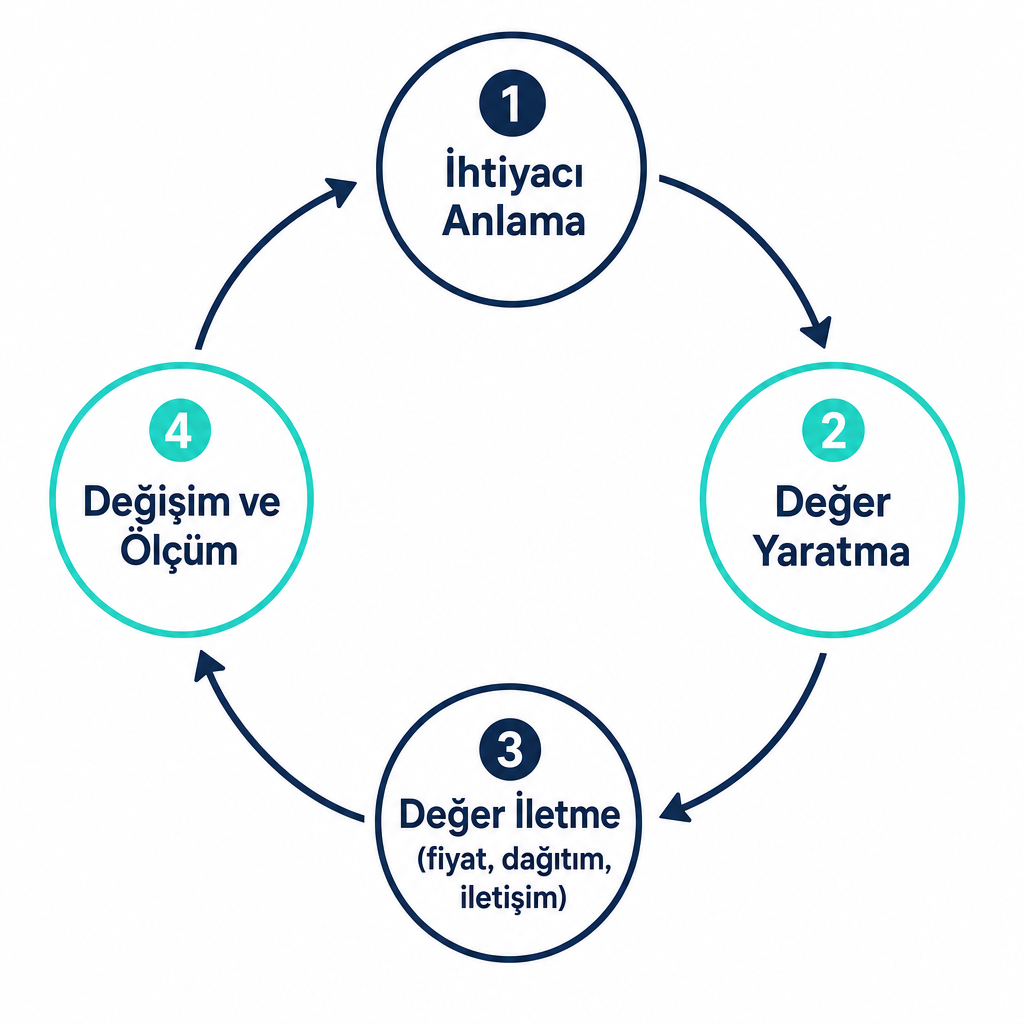
To understand marketing, it helps to think of it in terms of four mechanisms that feed into one another. Each mechanism uses the output of the previous one as input.
Understanding Needs and Expectations
Marketing begins with understanding customers' needs and expectations. Academic sources define marketing as the activity of analyzing customers' needs and expectations and, within this framework, planning how products and services will be designed and offered. At this stage, market research, customer segmentation, and deriving insights play a critical role; thus, the question "to whom and for which real problem am I offering my product?" becomes clear.
Creating Value: Product and Experience Design
The marketing literature addresses the subject not only in terms of sales but also together with the process of creating and developing products, services, and even ideas. For this reason, marketing encompasses product features, packaging, branding decisions, and the total experience offered. The goal here is to put forward a value proposition that is shaped according to the customer's wants and needs, that differentiates from competitors, and that is sustainable.
Communicating Value: Pricing, Distribution, and Communication
The elements of pricing, promotion, and distribution emphasized in the definitions constitute marketing's value-communication mechanism. Pricing aims to find a balanced point between the business's profitability goals and the value perceived by the customer. Distribution defines through which channels the product or service reaches the customer (store, dealer, website, marketplace). Promotion, on the other hand, communicates the value proposition through tools such as advertising, public relations, content marketing, and sales teams. In current literature, these elements are placed within the framework of "integrated marketing communication" together with the customer journey and experience design.
Exchange and Measurement: Managing Results
The phrase "carrying out exchanges" mentioned in the definitions shows that the ultimate goal of marketing is not merely to attract attention but to create a meaningful exchange (purchase, sign-up, subscription). For this reason, the marketing process is continuously improved by tracking performance metrics such as sales, conversion rate, and customer lifetime value through analytics tools. For those who want to determine which metric to prioritize, our short and practical tips section offers a handy reference to start with.
Digital Marketing: The Online Face of Marketing
Digital marketing is the carrying out of marketing activities through digital channels such as search engines, websites, social media, email, and mobile applications. Organizations define it as the entirety of tactics and technologies used to reach the target market and highlight products or services by using online channels and digital technologies.
Within this framework, digital marketing is a broad set of activities that includes becoming visible through search engine marketing and SEO, increasing brand awareness and engagement with social media content, managing relationships with email and automation, and, on e-commerce sites, tracking performance through conversion optimization and analytics.
The main point that distinguishes digital marketing from classic marketing is its measurability, targeting capability, and optimization potential. Being able to see which audience a campaign works with and redirect the budget accordingly makes digital channels a critical competitive tool for businesses of every scale. Those who want to follow current developments in the field can regularly monitor our digital marketing agenda and updates page.
Making Marketing Decisions for Beginners
For someone new to marketing, the most challenging part is not knowing where to start and how to set priorities. Clarifying the following decision areas builds a solid foundation:
- Target audience and market: Who are you addressing; what are this audience's core needs?
- Value proposition: Unlike competitors, which problem do you solve and how, and what benefit do you offer?
- Channels: Where does your target audience spend the most time; which offline and digital channels are priorities?
- Goals and metrics: What are your clear goals such as awareness, traffic, sales, or leads, and the corresponding KPIs?
- Resources and budget: What are your time, team, technology, and financial resources; how do you build a sustainable plan?
Handling these decisions systematically is critical for striking a balance between long-term brand building and short-term sales goals. For readers who want to reinforce fundamental concepts with examples, our marketing training guide covers these decision areas step by step.
Risks to Watch Out for in Marketing
When planning the marketing process, some common mistakes come up again and again. Knowing them in advance reduces the loss of budget and time.
- Producing campaigns without understanding the customer: Campaigns that are not based on research and insight struggle to connect with the target audience and lead to budget waste.
- Not focusing on the customer: Since the literature defines marketing as the activity of "carrying out exchanges in order to satisfy people's needs," shifting from a customer focus to a product focus is a strategic mistake.
- Marketing without measurement: Not tracking performance metrics on digital channels prevents you from seeing which activities truly generate value.
- Short-term manipulative communication: Messages that are solely sales-oriented, exaggerated, or misleading may produce results in the short term but create a loss of trust in the long term.
Because academic sources also emphasize marketing's responsibility to create value for society, they note that unethical practices carry serious risks in terms of brand reputation and sustainability. For e-commerce readers who want to start looking at the right metric, our guide to increasing e-commerce conversion rate is a concrete starting point.
Getting Started with Marketing Using Digigund
For those new to digital marketing, content resources that simplify complex concepts while also offering practical KPIs and tips significantly shorten the learning curve. The digital marketing ecosystem in Turkey shows a strong need for guide- and glossary-type content aimed at the beginner level on topics such as SEO, Google Ads, e-commerce, and analytics.
At digigund, we too aim to take marketing out of being an abstract theory and turn it into an applicable skill area for students, e-commerce managers, and performance marketing specialists. The components we offer together for this purpose are as follows:
- Digital marketing terms glossary
- Practical tips and KPI-focused mini guides
- Free digital marketing tools
- Current news and agenda content
While explaining fundamental concepts, this content progresses through examples, critical metrics, and common mistakes, bringing together both theory and practice in one place. In this way, the learning journey that starts with the question "what is marketing" advances seamlessly to concrete skills such as looking at the right metric and avoiding campaign mistakes.
Frequently Asked Questions
Are marketing and sales the same thing?
Sales is just one of the outcomes of marketing. Marketing is a broader management process that handles understanding customer needs, creating value, communication, and relationship management together.
Is marketing just advertising?
No. Advertising is the communication (promotion) component of marketing. Marketing also includes product and service development, pricing, distribution, and customer experience design.
What is the difference between digital marketing and classic marketing?
The basic principles are similar; the difference lies in the channels used. Digital marketing reaches the target audience and runs measurable campaigns by using online channels such as search engines, social media, email, and websites.
If I'm new to marketing, what should I learn first?
The priority is to understand the basic definition of marketing, the concepts of target audience and value proposition, and then digital channels, core metrics, and an analytical perspective.
Why is marketing critical for someone running an e-commerce business?
For e-commerce sites, marketing is a critical lever for attracting the right traffic, increasing conversion rates such as add-to-cart and checkout completion, reducing cart abandonment, and creating long-term customer value.