
Practical Guides
Log in to saveWhat Is Marketing Training? A Guide for Beginners
12 min read

Marketing education is a structured learning process that teaches, both theoretically and practically, how to deliver products or services to the right audience with the right message through the right channels. So the question is not "should I get marketing education?"; it is what type, over what duration, and toward what goal your education should be. In Turkey, this journey spans a wide spectrum ranging from four-year bachelor's and two-year associate degree programs to master's degrees, from short certificate programs to online courses focused on digital marketing. To make the right decision, you first need to clarify what you want to learn, and then what you want to do.
In this guide, you will find the definition of marketing education, the teaching mechanism behind it, the types of options, and the criteria you should consider when making the right choice, all together. Our aim is to enable you to distinguish, with concrete measures, which of the academic and applied paths suits you.
Table of Contents
What is marketing education?
Marketing, as defined by the American Marketing Association, is the set of activities and processes for creating and communicating offerings that have value for customers, partners, and society. Marketing education, in turn, encompasses every kind of structured program that systematically teaches these fundamental concepts, strategies, and tools.
Under this definition fall four-year bachelor's programs, master's degrees in brand management, two-year associate degree programs, short certificate courses, and digital marketing–focused online courses. In Turkey, universities' marketing bachelor's programs, building on this concept, offer the opportunity to specialize in areas such as brand management, pricing, distribution channels, marketing communications, marketing research, and international marketing.
What matters is recognizing that the heading "education" represents not a single format but a set of options that differ from one another in duration, depth, and purpose. That is why, when making the right decision, you first need to define your goal.
The decision question: Which education do you need?
The decision you really need to clarify is this: do you want a long-term academic path, or a skill-focused path you can immediately apply to your current job? This distinction directly determines the time you will spend, the cost, and the output you will gain.
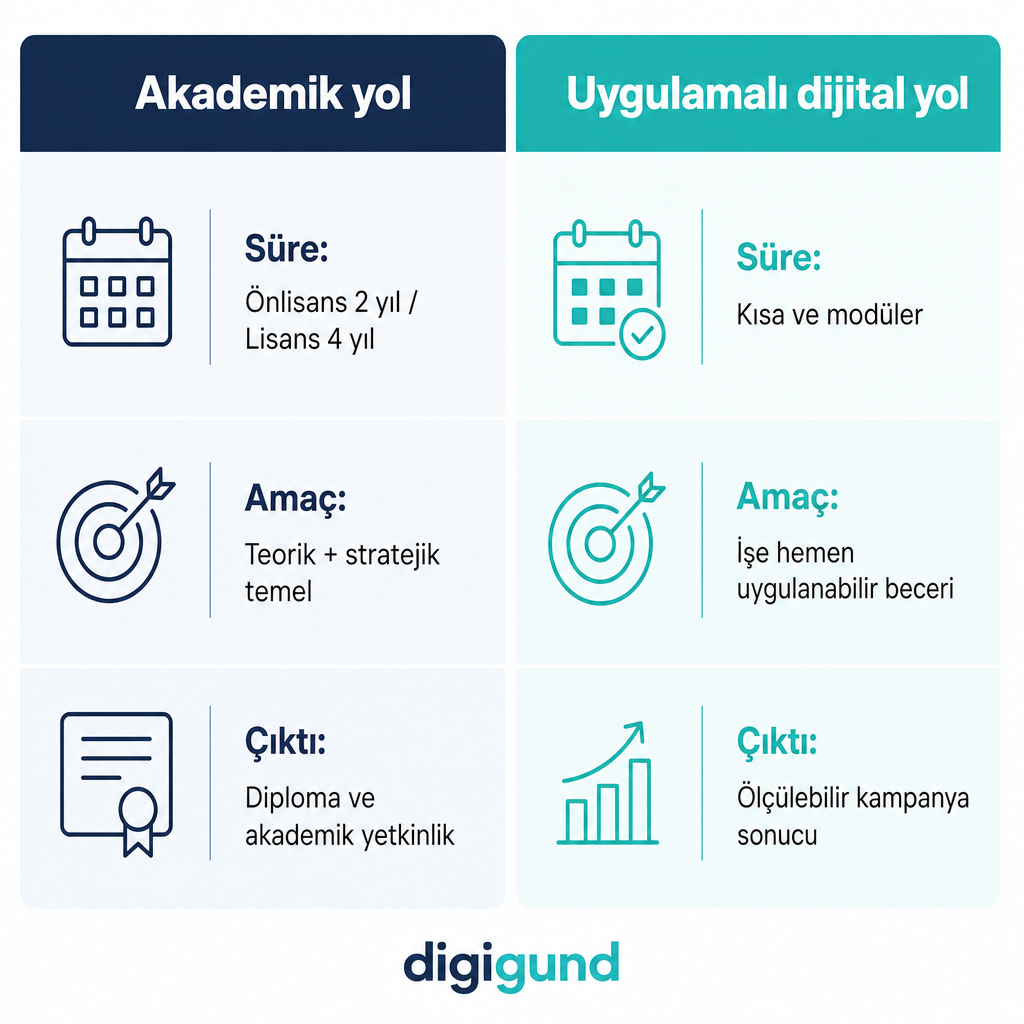
In Turkey, marketing associate degree programs generally last two years (four semesters), while bachelor's programs last four years (eight semesters). These programs aim to establish the principles of marketing and case applications on a foundation of business and management. By contrast, online and modular digital marketing courses are shorter; they focus on practice and are designed for those who want to apply what they learn to their current work right away.
To simplify the decision, it is enough to look at two axes: your time horizon (a few weeks or a few years) and your output expectation (a diploma and academic competence, or a measurable campaign result). If you determine where you stand on these two axes, the rest of the choice narrows down on its own. Our content explaining who marketing education is suitable for and where to start can be a supporting starting point when making this decision.
What and how does marketing education teach?
The way marketing education works is built on three mechanisms, and you can evaluate the quality of a program by the balance of these three components.
The first is the conceptual framework and theories. The core marketing courses at universities focus on teaching subjects such as the marketing mix (4P), consumer behavior, market segmentation, positioning, and customer value and satisfaction. This layer establishes the common language on which every subsequent decision rests.
The second is applied work and case analyses. Bachelor's and master's programs aim to provide practice in solving real business problems through case analysis, projects, and applied assignments. Developing a pricing strategy for a product, carrying out positioning work for a new brand, or planning a campaign across digital channels are learned in this layer. This is the very component that turns theory into problem-solving.
The third is the current digital environment and tools. Many programs, alongside classic concepts, also include electronic marketing, social media, database marketing, and new developments in digital channels. In digital marketing courses, Google Ads and social media advertising, SEO and content marketing, and analytics and measurement tools are addressed at both the theoretical and tool-usage levels.
At digigund, for those who want to learn marketing and especially digital marketing, we offer a glossary, practical guides, current news, and free digital marketing tools under one roof. In this way, we make it easier for you to turn theory into practice with KPI-focused guides and tools.
Types of marketing education and who they suit
Thinking of the options in three main groups makes it easier to see which one suits you.
University and associate degree programs. In Turkey, there are both two-year associate degree and four-year bachelor's programs in the field of marketing. These programs aim to instill the profession's core skills through theoretical and practical education; to provide fundamental knowledge in areas such as marketing management, brand management, sales management, public relations, and advertising; and to train graduates who can make strategic marketing decisions in national and international businesses. Some programs also include current topics such as social marketing, sustainability, innovation, electronic marketing, and social media. It is the primary path for students who want to build their post-high-school careers in marketing.
Master's and specialization programs. Master's programs focused on marketing and brand management aim to train specialists who can manage a marketing department, create new and strong brands, and make strategic decisions. These programs are often designed for working professionals, in a distance-learning format, and with a practical emphasis. They are suitable for professionals who want to deepen their corporate careers.
Short courses and digital marketing training. These stand out for those who do not aim for an academic diploma but want to apply marketing directly to their work. These courses generally focus on basic marketing and digital marketing concepts, Google Ads and social media advertising, e-commerce performance tracking and measurement, and analytics and reporting. They are a practical path for entrepreneurs and SME owners who want to grow their own brands, e-commerce store owners and managers, and employees who want to move from sales or operations into marketing.
At digigund, we offer a reliable and instructive starting point for beginner-level users stepping into digital marketing, e-commerce managers, and those who want to strengthen their SEO and performance marketing practice. At this point, before diving into the subject, our beginner's guide explaining what digital marketing is makes a good first stop for establishing the fundamental concepts.
What does marketing education cover?
Even though the program type varies, marketing education generally includes a common core of knowledge and skills. Knowing this core enables you to quickly evaluate a program's content.
- Fundamental marketing principles: The basic concepts and strategies of marketing and the processes of creating customer value.
- Consumer behavior: Courses aimed at understanding consumers' needs, motivations, and decision processes.
- Brand management: Brand positioning, building brand identity, and brand communication.
- Marketing communications: Advertising, public relations, digital and social media communication.
- Sales and customer relations: Sales management, CRM, and customer satisfaction management.
- Data-driven marketing and analytics: Collecting and analyzing marketing data and using it in decision-support processes.
- Digital marketing: Current topics such as electronic marketing, social media, email marketing, database marketing, and e-commerce.
Some of these areas are covered in detail in classic bachelor's programs; digital marketing courses, on the other hand, place more emphasis on online channels, measurement, and performance-focused campaigns in particular. In our practical guides, we explain topics such as digital marketing fundamentals, methods for reducing cart abandonment, and how to read campaign metrics, along with theory and directly applicable examples.
Criteria for choosing the right education
After you have seen the options, the decision becomes clear with a few concrete criteria. The headings below help you match program descriptions with your expectations.
Goals and time horizon. For those planning an academic diploma and a long-term career, a four-year bachelor's and a subsequent master's is more suitable. For those who want to see results in a short time in their current jobs, short, modular, and applied digital marketing courses may be more meaningful.
Currency of content and digital focus. Up-to-date programs, alongside classic theories, also cover areas such as electronic marketing, social media, and innovation. If the course content lacks digital marketing, data analytics, and measurement, in a period where digital channels are so decisive, the education can quickly become outdated.
Official recognition and accreditation. University and associate degree programs are leveled according to the national qualification frameworks set by the Council of Higher Education; for example, level 5 of the TQF-HE applies to associate degree programs. For a marketing bachelor's diploma, certain ECTS credits must be completed and a certain grade point average must be reached. This formality is important for those targeting a corporate career.
Practice and project opportunities. The presence of case studies, project courses, and practice-oriented content in program descriptions supports graduates being trained to a level where they can design real campaigns. In digital marketing courses, real campaign examples, KPI tracking and reporting, and tool usage (for example, estimated click and impression calculators) are an important indicator of quality.
Additional resources and community support. Platforms offering a glossary of terms, KPI guides, current news, free tools, and community support accelerate the learning process. At digigund, we make the decision process easier for beginner-level users by offering, all together, concepts through our glossary of digital marketing terms, KPIs and metrics through our practical information section, developments through current industry news, and free digital marketing tools through our tools section.
Risks and what to avoid
The most common mistakes when choosing an education fall under a few headings and, when known in advance, are easily eliminated.
- Risk of outdated content: Programs that do not cover digital marketing, social media, and data-driven marketing can leave you behind the competition.
- Certificate-only focus: Courses that promise only a certificate without a strong content structure may not create the expected impact in the job market.
- Education without application: Programs that contain no projects or case studies and are entirely theoretical may fall short in instilling the ability to solve real business problems.
- Choosing the wrong level: For someone who does not want a long academic path, a four-year bachelor's can be too long and costly; conversely, for a professional who wants to change careers, a short but intensive digital marketing course is more appropriate.
For this reason, it is critically important to carefully examine program descriptions, course contents, and qualification statements and match them with your expectations. The choice is about finding the format that suits you; there is no generally "best" type of education.
How to structure your learning journey with digigund
At digigund, we offer a structured yet flexible learning experience for beginner and intermediate users with a glossary section that explains fundamental concepts in digital marketing, practical guides focused on KPIs and metrics, a news section where you can follow the agenda, and free tools that calculate estimated clicks, impressions, and reach.
You can use these resources in different ways depending on your goal. A student preparing for a university or associate degree program can use the fundamental concepts and current digital trends as supporting resources. An e-commerce owner or manager can gain information that directly improves campaign performance thanks to practical KPI guides and tools. Those interested in SEO and performance marketing, meanwhile, can make campaign management more systematic with measurement- and analytics-focused content.
Your next step goes through clarifying which type of education suits you: determine your goal and time horizon, then reinforce the fundamental concepts from the glossary and test what you have learned with practical guides and free tools. If you share with us the level you need, your current experience, and your priority goal, we can suggest the learning starting point most suitable for you.
Frequently Asked Questions
Can you do marketing without getting marketing education?
It is possible to carry out sales or marketing activities without theoretical education. However, universities and official programs aim to systematically instill strategic decision-making and data-driven working skills; this, in turn, makes it easier to produce more consistent results in the long run.
How many years does a marketing bachelor's program last?
In Turkey, marketing bachelor's programs generally last four years (eight semesters). Associate degree programs, on the other hand, are structured as two years (four semesters).
What are the official requirements for a marketing bachelor's diploma?
According to the official definitions, to obtain a marketing bachelor's diploma, 240 ECTS must be completed and a certain grade point average must be reached (for example, at least 2.00 out of 4.00).
What is the difference between digital marketing education and classic marketing education?
Classic programs devote extensive space to topics such as basic marketing theories, consumer behavior, and brand management. Digital marketing courses, on the other hand, focus on putting this knowledge into practice through online channels, advertising platforms, and analytics tools.
How can I use digigund for marketing education?
You can start from the glossary to understand fundamental concepts, then learn KPIs and metrics with the guides in the practical information section, follow developments in the industry through the news section, and reinforce your learning by testing the potential performance of your campaigns with free tools.