
Practical Guides
Log in to saveWhat Is Marketing Training, and Who Is It For?
11 min read

Marketing education is a structured learning process that teaches how to connect products or services with the right target audience, promote them strategically, and produce measurable results. It is offered in different formats ranging from university programs to online courses, from corporate certifications to hands-on workshops; it is suitable both for those just starting their careers and for professionals looking to grow their existing business. In this guide, we clarify what we count as "marketing education," explain the mechanisms behind what you learn in such training, and show, using decision criteria, which profile gravitates toward which format.
Table of Contents
What exactly does marketing education cover?
Marketing is a strategic process of understanding customer needs, creating value propositions suited to those needs, and delivering them to the target audience through effective communication and distribution channels. Marketing education teaches the logic behind this process systematically: it addresses, in an integrated framework, how consumer behavior works, how market research is conducted, brand building and positioning strategies, communication and advertising principles, and how digital channels (search engines, social media, email, websites, mobile apps) are used in marketing.
In other words, a good marketing education is built on fundamental business principles and aims to equip participants with an understanding of how the market works, how consumers make decisions, and how to develop effective strategies. In this process, participants learn marketing terms, core concepts, marketing language, and basic sales techniques. Most of these terms seem unfamiliar at first; to quickly clarify the concepts, you can make use of our digital marketing glossary.
What do we mean by "marketing education"?
In Turkey, the term "marketing education" is used for structures that are quite different from one another. Before making a decision, clarifying which one you are talking about is decisive in terms of both time and budget:
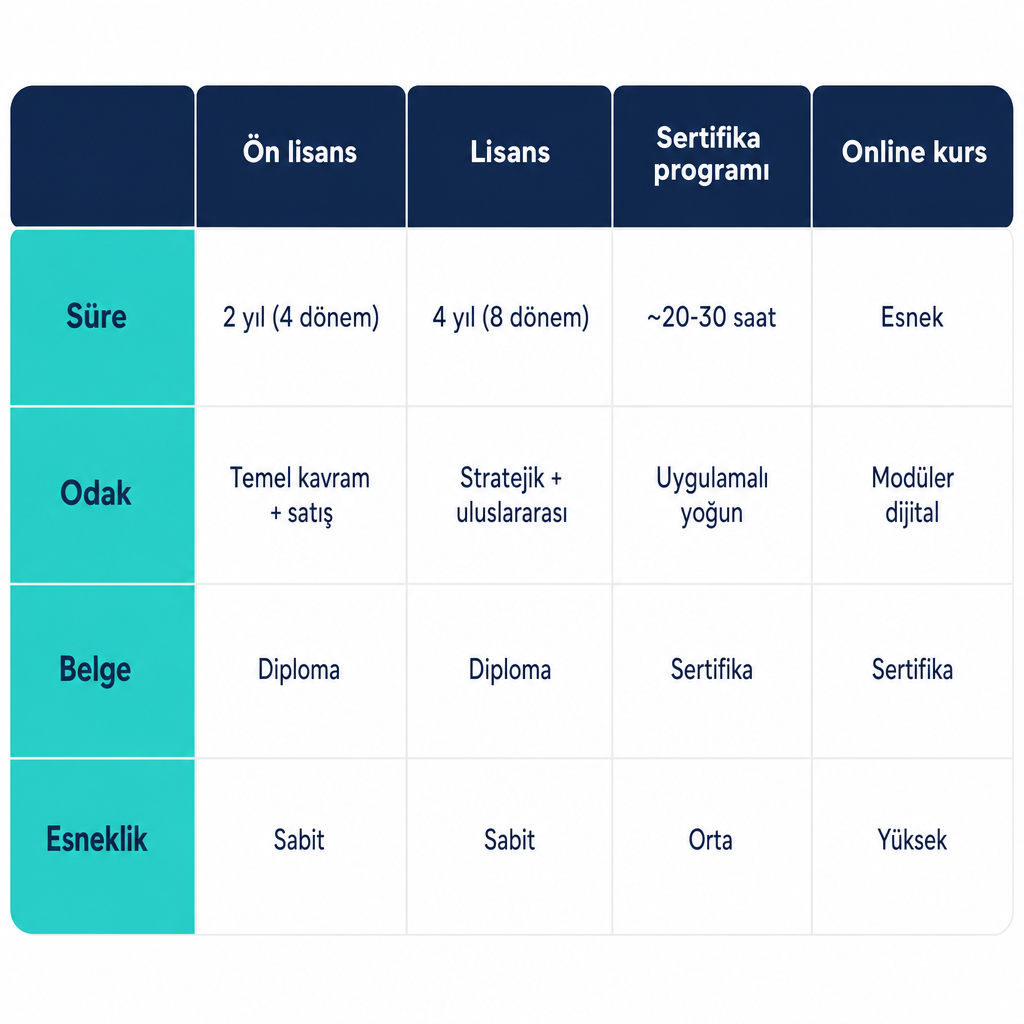
- University programs: 2-year associate degree and 4-year bachelor's degree marketing departments; they provide theoretical and practical training in marketing strategies, consumer behavior, brand management, advertising, digital media, and market research. Associate degree programs typically last 2 years (4 semesters), while bachelor's programs last 4 years (8 semesters).
- Certificate programs of corporate academies: shorter and more application-oriented content under headings such as "Sales and Marketing Management" and "Marketing Management Certificate Program."
- Online sales and digital marketing courses: formats offering flexibility of time and place, covering basic and advanced modules.
- Short intensive programs titled "Basic Marketing Education": options that teach principles and current techniques through condensed content.
The key question to answer when deciding is this: Do you want an academic diploma, an industry-focused and quickly applicable certificate, or to improve your digital marketing knowledge at your own pace with practical content? These three directions lead to entirely different paths in terms of duration, cost, and depth of learning.
What do you learn in a marketing course?
Whatever the name of the training, a strong curriculum rests on several mechanisms that feed into one another. Recognizing these makes it easier to evaluate whether the program in front of you will genuinely build competence.
Fundamental marketing and business logic
University and professional programs begin with courses such as introduction to marketing, microeconomics, business communication, and statistics to teach the logic behind marketing decisions. At this stage, the marketing mix (product, price, place, promotion), customer segmentation and targeting methods, competition analysis, and positioning strategies are addressed within an analytical framework.
Consumer behavior and market research
The psychology of purchasing decisions and the techniques of collecting and analyzing market data are areas that a good education particularly emphasizes. Research methods such as focus groups, surveys, and observation, ways to make sense of data and generate insights, and developing messages suited to the target audience are studied through applied examples.
Brand management and communication
Brand building, positioning, brand identity, and campaign design are at the center of the education. The aim is for the brand to create a consistent perception map, communicate this perception through the right channels, and manage long-term brand value.
The digital marketing dimension
In modern marketing education, digital marketing is no longer an auxiliary module but an indispensable axis. Digital marketing refers to the process of promoting and marketing products or services to the target audience using the internet and digital technologies. In this scope, the training covers topics such as search engine optimization (SEO), social media marketing, email marketing, content marketing, pay-per-click (PPC) and search engine advertising, along with web analytics and conversion optimization. For those who want to grasp this axis from scratch, our digital marketing guide for beginners is a good starting point. An important difference of digital marketing is that the entire process is measurable and makes it possible to reach the target audience directly, often in a personalized manner.
Measurement, KPIs, and analytics
Strong training aims to develop professionals who can interpret campaign results, define key performance indicators (KPIs), and adjust their strategy based on data. Students learn metrics such as traffic, impressions, clicks, conversions, cart abandonment rate, and customer lifetime value; which metric is critical for which business goal; and the cycle of reading, interpreting, and optimizing reports.
Types of marketing education and options
Separating the options along the axes of duration and depth makes it easier to see which path suits your situation:
| Format | Typical duration | Highlighted content | Suitable profile |
|---|---|---|---|
| Associate degree | 2 years | Basic concepts, sales techniques, business logic | Newcomers to the industry |
| Bachelor's degree | 4 years | Strategic and international marketing, digital communication, internship | Those seeking an academic foundation |
| Certificate program | ~20-30 hours | Sales/marketing management, applied intensive content | Those seeking quick competence |
| Online course | Flexible | Basic and advanced digital marketing modules | Self-paced learners |
Most of these options strengthen the career profile by granting graduates a certificate or diploma and increase employability in the marketing field. While bachelor's programs offer strategic depth and internship opportunities, certificates and online courses aim to deliver concrete business results in a shorter time.
Who is it suitable for?
Marketing education does not appeal to a single audience; each profile gets the most benefit from a different format.
Beginners and students. For university candidates or students who aim to make marketing their profession, education provides the theoretical and practical framework that forms the foundation of a career. For this group, university marketing departments as well as basic marketing education and entry-level digital marketing courses are especially suitable.
E-commerce store owners and managers. For e-commerce businesses, education is much more than driving traffic; it makes a difference in areas such as increasing conversion rate, reducing cart abandonment, and managing customer lifetime value. E-commerce-focused programs teach how to integrate digital channels and how to measure and optimize campaigns.
SEO and performance marketing specialists. For those working in areas such as SEO, Google Ads, and social media advertising, education provides the opportunity to place technical knowledge within a strategic framework. This group typically deepens on both the strategy and campaign optimization side through digital marketing-focused certificate programs and courses that include SEO, performance marketing, and analytics modules.
Professionals wanting to change careers. For those wanting to move into marketing from a different field, short-term sales and marketing courses intensively present both fundamental concepts and techniques adapted to the business world. These trainings target quick competence in customer analysis, campaign planning, and interpreting results.
Decision criteria for choosing the right education
Five criteria stand out to help you make a sound decision among the options:
Your goal and time horizon. Are you aiming for a diploma-based career (2–4 year programs), or are you looking for practical training that will produce concrete business results in a short time (certificates, online courses)? This distinction directly determines your cost and time expectations.
Content scope. Does the education only cover classic marketing theory, or does it also include the layers of digital marketing, e-commerce, analytics, and measurement? Current programs treat SEO, social media, email, PPC, and analytics as a natural part of strategy.
Practice and project intensity. Programs that only teach theory may leave real campaign design and optimization capability limited. Programs offering market research, real case studies, projects, and internship opportunities build more sustainable competence.
Measurement and data literacy. Defining KPIs, interpreting data, and the optimization cycle are at the heart of modern marketing. A good education doesn't just list metrics; it ties them to business goals and integrates them into decision-making processes.
Official recognition and industry connection. University diplomas and corporate certificate programs provide an additional advantage in terms of employability and career advancement. Programs with corporate connections generate practical benefits through internship and networking opportunities.
Risks and common mistakes
The most common pitfalls in choosing education mostly stem from a lack of scope and currency:
- Gravitating toward purely theoretical programs without practice. Theory is important; however, without the experience of designing campaigns, analyzing metrics, and optimizing, marketing skills remain incomplete.
- Ignoring the digital dimension. Digital channels have become the main stage of marketing; trainings that teach only traditional marketing may fall short, especially in e-commerce and performance marketing careers.
- Content disconnected from the Turkish market. Marketing is highly sensitive to market context; it is necessary to see examples with up-to-date data that align with consumer behavior, competitive structure, and the digital ecosystem in Turkey.
- Programs that give no place to the measurement and KPI dimension. Campaigns that cannot be measured cannot be optimized; this leads to budget waste and weak results.
To reduce these risks, it is wise to examine the curriculum of the programs and the currency of the topics covered, and, if possible, to evaluate sample lesson content and instructor profiles.
Supporting your marketing education with digigund
We design digigund as a learning platform that brings together a digital marketing glossary, practical tips, news, and free tools under one roof, in order to strengthen the practical side of marketing education. Whether you are in an academic program or just starting with an online course, we make it easier for you to adapt what you learn to the Turkish digital marketing ecosystem.
- Glossary: We explain digital marketing terms with beginner-friendly definitions, quickly clarifying the concepts you encounter in classes or courses.
- Practical tips: With short lists and guides, we show which metric you should look at, which mistakes to avoid, and what to pay attention to in advertising through concrete examples; thus we connect theoretical knowledge to daily operations. You can take a look at the topic in our practical tips section.
- News: With updates and current developments in the world of digital marketing, we help you keep the strategies you learn up to date with new platform changes and trends.
- Free tools: Our free digital marketing tools provide a data-based starting point for your campaigns by calculating estimated click, impression, and reach ranges based on industry, target audience, and monthly budget.
If you are unclear about which education path to pursue, share with us your goal, the time you can allocate, your current experience level, and the topics you want to learn, and we will recommend a resource and learning plan suited to your situation.
Frequently Asked Questions (FAQ)
Are marketing education and digital marketing education the same thing?
No. Marketing education is a broad framework covering both traditional and digital channels; digital marketing education, on the other hand, is a sub-field focused on marketing activities carried out through the internet and digital technologies.
Is it necessary to attend university to receive marketing education in Turkey?
No. University programs offer a strong foundation; however, it is also possible to enter the industry with sales and marketing certificates, online marketing courses, and digital marketing training.
Which type of education is more suitable for someone with an e-commerce store?
Digital marketing-focused training that includes e-commerce and conversion optimization is more suitable; through SEO, performance advertising, and analytics modules, it helps convert traffic gains into sales.
Why is the official recognition of marketing training important?
Diplomas and recognized certificates allow employers to objectively evaluate your level of knowledge and create an additional element of confidence for career advancement.
How does digigund contribute to someone receiving marketing education?
With our glossary explaining terms, our practical KPI and mistake guides, our current news, and our free tools, we offer a practical learning environment that makes it easier for you to turn the theory you learn into daily campaign decisions.