Practical Guides
Log in to saveWhat Is Marketing Education, and Where Do You Start?
11 min read

Marketing education encompasses all systematic learning programs that teach how to position a product or service to the right target audience, design campaigns across traditional and digital channels, and measure results with data. Where to begin, however, doesn't depend on a single correct path; it depends on your career goals, your current level of knowledge, and the time and budget you can allocate. The right starting point for a student may differ from the right starting point for an e‑commerce owner looking to grow their store. In this guide, we first clarify what marketing education is and how it works, then explain the decision criteria, learning paths, and common mistakes within a practical framework.
Table of contents
What is marketing education?
In the classic sense, marketing education covers programs that impart the ability to develop, implement, and manage strategies to deliver a product or service to the right target audience. Such programs address fundamental topics such as the 4Ps of marketing (product, price, place, promotion), positioning, brand management, and consumer behavior.
Digital marketing education, on the other hand, consists of specialized programs that holistically teach digital channels such as search engines, social media, email, content marketing, and data analytics. Digital marketing is built on promoting products and brands through electronic devices and the internet, running campaigns across multiple channels, and analyzing results in real time. For this reason, digital marketing programs emphasize producing measurable results and making data-driven decisions.
In Turkey, university continuing education centers, private academies, and online course platforms offer programs that include both theoretical and applied lessons in areas such as SEO, social media management, ad planning, content production, and data analysis. The fundamental difference between the two areas is this: classic marketing builds your framework of thought, while digital marketing carries that framework into measurable channels. A solid marketing education most often connects the two.
The core mechanisms of marketing education
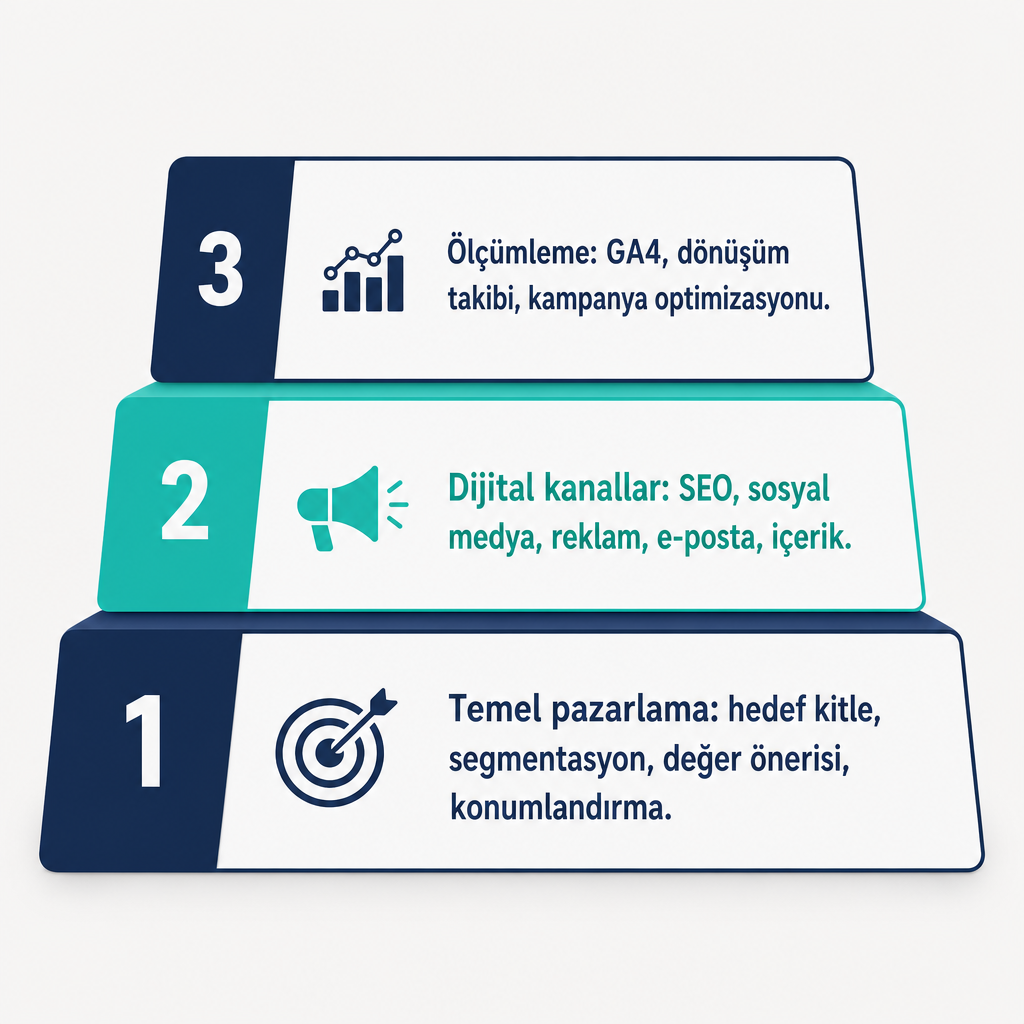
A marketing education's ability to turn knowledge into skill relies on several complementary mechanisms. In a good program, all of these are present together; when one is missing, learning remains incomplete.
- Core marketing foundation: Provides an analytical perspective on topics such as target audience selection, segmentation, value proposition, and brand positioning. Without this layer, channel knowledge stays up in the air.
- Systematic teaching of digital channels: Areas ranging from search engine optimization to social media advertising, from content strategy to data analytics are covered in modules.
- Strategy and campaign design: Steps such as building an online presence, campaign planning, choosing the right channel, and budget estimation are demonstrated through example scenarios.
- Data analysis and measurement: The ability to read web traffic, campaign performance, and conversion rates with tools like Google Analytics 4 and similar sits at the center of modern education.
- Applied projects and case studies: Quality programs provide practice in building campaigns, optimization, and reporting on real datasets.
The format in which these mechanisms are delivered also matters. Online programs offer flexibilities such as learning at your own pace, rewatching content, and participating from different cities. Face-to-face certificate programs, on the other hand, can provide classroom discipline, instant feedback, and strong networking advantages. The right choice depends on your learning style and schedule. To close gaps at the channel and terminology level, having a digital marketing terms glossary at hand makes following the modules easier.
Why and how should you start?
The decision to start a marketing education generally arises from three main motivations. Which one you're closest to determines your starting level and the type of education you should choose.
- Career builders: Students and new graduates who want to begin their careers in marketing or digital marketing.
- Business growers: Entrepreneurs and business owners who want to learn advertising, SEO, and conversion optimization to grow their existing business or e‑commerce store.
- Specialists: Marketing professionals who want to deepen their expertise in SEO, performance marketing, or data analytics.
Your decision becomes clear with this question: do you want marketing education for a career change, to scale your existing business, or to gain a specific expertise — for example, only Google Ads or SEO? If you're considering a career change, it makes sense to start with a broad-scope foundational program. If you want to grow your business, you can focus directly on advertising and conversion optimization. If you've come with the goal of deepening in a single channel, an advanced program concentrating on that area will be more efficient. If you're still far from the whole of marketing, reading our digital marketing guide for beginners first will strengthen your foundation.
Where to start? Learning paths and options
In Turkey, there are several fundamental paths you can start with, at different depths and formats. Rather than being alternatives to one another, they most often deliver the best results when used together.
Building a solid foundation. The digital marketing certificate programs offered by university continuing education centers and accredited private academies are designed to teach digital channels holistically along with the fundamental principles of marketing. In these programs, SEO, social media, ad planning, content production, and data analysis are covered both theoretically and practically. Free foundational programs on national platforms like BTK Akademi also offer an accessible first step for beginners who want to get to know the ecosystem.
Learning flexibly and modularly with online courses. Online courses offer search engine optimization, social media advertising, content strategy, and data analytics in modules. Quality online programs generally follow this order:
- Fundamental concepts (what is digital marketing, channel types, customer journey)
- Specialization modules (SEO, Google Ads, Meta Ads, email marketing)
- Measurement and reporting (Analytics, conversion tracking)
This format is a strong starting option for working professionals, those living in different cities, and those who want to progress at their own pace.
Progressing with a practice focus using your own project and free resources. For learning to be lasting, it's critical to support education with a real project. By using your own blog, a small e‑commerce site, or a business around you as a "testing ground," you can put topics such as campaign design, applying SEO, planning an advertising budget, and conversion optimization into practice. You can make this approach more systematic by supporting conceptual learning with reliable information sources and free digital marketing tools.
Decision criteria when choosing a marketing education
Since marketing education is a commercial investment, you need to evaluate which program to choose with clear criteria. The headings below help you see the difference between a program's promise on paper and its equivalent in practice.
| Criterion | What to look for | Weak signal |
|---|---|---|
| Content scope | Balance of core marketing + SEO, social media, advertising, content, and analytics | Content confined to a single channel (e.g., Instagram only) |
| Instructor and currency | Real industry experience and recently updated content | Old case examples, outdated screenshots |
| Opportunity for practice | Building real campaigns, data analysis, preparing reports | Only slides and theoretical explanation |
| Certificate value | Recognition in the industry and being supported by a portfolio | A certificate alone without a portfolio and project output |
| Feedback and support | Participant reviews, mentor support, community access | Unreachable instructor, absence of feedback |
Content scope determines the breadth of your career; programs that focus on only a single channel may fall short in the long run. The instructor's real experience and the currency of the content are decisive quality indicators in a rapidly changing field like digital marketing. Live applications in tools such as GA4, Google Ads, or Meta Ads in particular are critically important for those entering performance marketing. Having a certificate that carries weight in the industry makes a difference in job applications; however, a certificate alone is not enough — it should be supported with a portfolio and concrete project outputs. Reviews from previous participants and mentor/community support, on the other hand, give a good idea about the sustainability of the learning process.
Risks encountered when making a choice
In the marketing education market, content promising "guaranteed income" or "expertise in a few weeks" in a short time poses a risk, especially for beginners. When the following traps are ignored, your investment may not deliver the return you expect.
- Overly certificate-focused approach: Participants who target only the certificate without producing practice struggle in job interviews when asked about real campaign examples and measurement experience.
- Outdated content: Programs that explain old platform interfaces, discontinued features, or earlier analytics versions instead of GA4 don't prepare you for current applications.
- Learning confined to a single channel: Programs focused only on social media keep your skills within a narrow frame by leaving out areas such as SEO, search ads, and analytics.
- Neglecting measurement: Programs that don't teach data-driven decision making produce marketers who can't read campaign results and can't optimize.
To reduce these risks, it's wise to carefully examine the program's syllabus, its last update date, the instructor's background, and student feedback before enrolling. And to keep what you've learned current, you need to follow the industry agenda; the digital marketing agenda and updates make things easier for you at this point.
Making learning sustainable with Digigund
At Digigund, we offer an informational learning platform that brings together a digital marketing glossary, practical knowledge, news, and free tools in one place. By providing both conceptual and practical content in areas such as Google Ads, SEO, e‑commerce, and measurement, we aim to be a reliable reference point especially for beginners.
- Glossary: By defining digital marketing terms clearly and in a beginner-friendly way, we help you quickly clarify the jargon you encounter in courses.
- Practical knowledge: We bridge theory and daily application by offering KPI-focused short guides and practical tips through short lists such as "which metric should you look at, which mistakes should you avoid."
- News: By following the agenda and important platform changes, we support you in keeping the knowledge you learn in courses up to date.
- Free tools: With tools that help calculate estimated clicks, impressions, and reach ranges based on your budget, industry, and target audience, we make it easier for you to form realistic expectations when planning campaigns.
Thanks to this structure, we move marketing education away from being a closed package that's taken once and finished; we complete it as a continuously updated learning space that keeps concept and application together. If you're looking for a practical companion resource to digest the content of the course you've taken, test your campaigns, and read the results, your right starting point is a clear goal and regular repetition. If you can't decide which topic to start with, determining your current level and goal and then progressing from resources appropriate to it is the most efficient path.
Frequently asked questions (FAQ)
Can I start marketing education completely from scratch?
Yes. Many foundational digital marketing programs are prepared to introduce the ecosystem and impart skills from scratch, with no prerequisites. Platforms that present terms and fundamental concepts in an understandable way also play a supportive role at the entry level.
Should I learn classic marketing or digital marketing first?
Classic marketing principles provide a strong foundation in concepts such as target audience, positioning, and value proposition. However, since knowing digital channels (SEO, social media, advertising, and analytics) is critical in today's job market, most education delivers these two areas in an integrated way.
Can I find a job in marketing with only online courses?
Well-structured online courses can impart fundamental knowledge and technical skills. However, employers look for real campaign experience, a portfolio, and data analytics skill in addition to a certificate. Therefore, it's important to support online learning with real projects and practical outputs.
What questions should I ask myself before investing?
Being able to clearly answer the questions "Does this education really impart the skills necessary for the role I'm targeting?", "Is the content current and applied?", "Does its certificate carry weight in the industry?", and "Do my time/budget resources suit this program?" makes the right choice easier.
Does Digigund replace a paid course?
Digigund is a knowledge and community space that supports your learning process with a glossary, practical guides, news, and free tools. Rather than replacing the structured lessons, mentorship, and certificate that paid courses offer, it takes on the role of a practice-focused companion resource that clarifies concepts with KPI and mistake guides.