
Practical Guides
Log in to saveHow Can You Increase Your E-commerce Conversion Rate?
9 min read

The short answer to the question of how to increase your e-commerce conversion rate is this: first measure your current rate accurately, then improve site speed, product pages, trust elements, and the checkout flow through data-backed steps. For small and medium-sized stores in Turkey, this is usually a 6-12 week effort that is low cost but high impact; you can typically see the first concrete results from simple changes within 2-4 weeks. This guide covers the entire flow, from which prerequisites you need to complete, to a step-by-step optimization plan, common mistakes, and the decision of whether to proceed on your own or with expert support.
Table of Contents
- Prerequisites you need to complete before starting
- Step-by-step conversion rate improvement plan
- Common mistakes and how to solve them
- When should you seek expert support?
- Frequently Asked Questions
Prerequisites you need to complete before starting
If you start optimization blindly, you'll never know which change actually worked. Don't move on to the improvement steps before completing the items below; these establish the measurement foundation of your CRO work.
- Have you correctly set up the "purchase" / "completed order" event in Google Analytics 4 or a similar analytics tool?
- Can you report total visitors and total order count on a daily or weekly basis?
- Can you see separate conversion rates for desktop and mobile?
- Do you have at least 1-3 months of historical traffic and order data?
- Have you measured your site speed at least once with a tool like Lighthouse or PageSpeed?
- Do you know your top 10 pages by traffic (especially product and category pages)?
- Can you see your cart abandonment rate or the abandonment percentages at the cart and checkout steps?
If you answered "no" to most of the items on this list, complete your measurement infrastructure first. If you're lacking in the basic concepts, our digital marketing guide for beginners is good preliminary reading. When you need free measurement and analysis tools, you can check out our digital marketing tools page.
Step-by-step conversion rate improvement plan
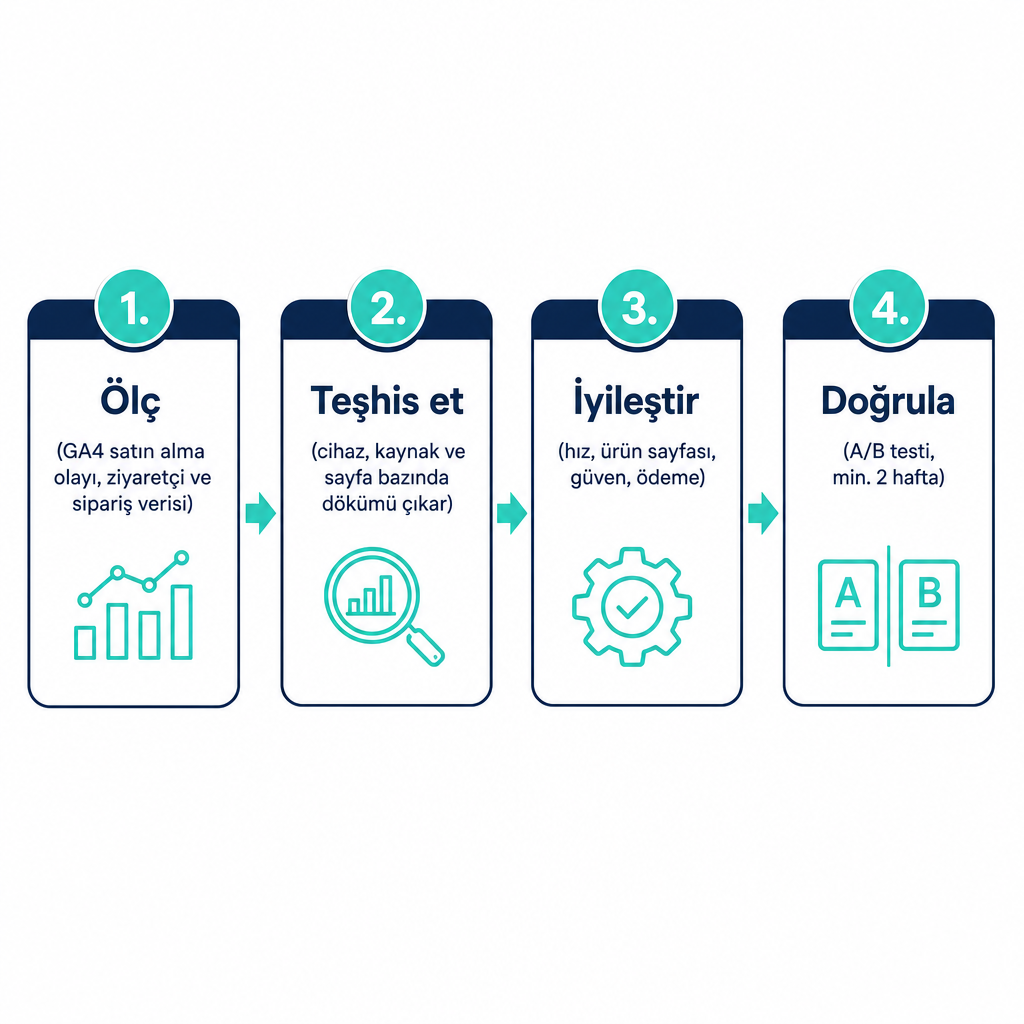
The order below is not random: first we measure and find where the loss is, then we move on to the highest-impact technical and experience improvements.
1. Measure and benchmark your conversion rate
Conversion rate is usually calculated with this formula: number of orders ÷ number of visitors × 100. You need a reference point for comparison: many sources show that the global average e-commerce conversion rate was around 1.6% in mid-2024, and that this rate can vary from under 1% to over 6% depending on the industry. Compare your own rate with both this general average and your competitors in your niche. For example, if you're below 0.5%, you most likely have fundamental UX and trust issues, and your priority should be closing these fundamental gaps rather than cosmetic touches.
2. Identify where the biggest loss occurs
Effective CRO work first finds the "bottleneck." In your analytics data, examine which pages generate add-to-cart actions and at which checkout step users drop off. With tools like GA4, break down conversion rates by device (mobile/desktop), traffic source (organic, ads, social), and page. Analyzing user behavior and planning A/B tests on the sales flow is the most concrete way to identify the points blocking conversion. Looking at a single overall rate hides whether the problem is on mobile or on a specific category page.
3. Improve site speed and technical performance
When page load time exceeds 3 seconds, user losses increase rapidly; slow-loading pages especially harm conversion on mobile. Site speed is one of the core metrics of conversion optimization. Actionable steps:
- Compress images, reduce unnecessary scripts and plugins.
- Use modern image formats like CDN, caching, and WebP.
These changes can mostly be made without coding knowledge and are among the steps with the fastest visible impact.
4. Make the mobile experience as strong as desktop
Most e-commerce traffic comes from mobile devices, so mobile compatibility is critical for conversion. Responsive design, easy navigation, and touch-friendly buttons are basic requirements. In practice:
- Simplify menus, remove unnecessary areas.
- Keep "Add to cart" and "Buy" buttons close to the screen, in a position that can be tapped with one hand.
If your mobile rate is significantly lower than desktop, adjust your priority order accordingly.
5. Turn product pages into a trust and persuasion machine
High-quality visuals, clear descriptions, and social proof have a strong impact on conversion. Use high-quality images from at least a few different angles, and add video if possible. Write product descriptions that are benefit-focused, properly titled, and SEO-friendly. Additionally:
- Don't hide critical information such as stock, shipping time, and return conditions; make them visible on the product page.
- Highlight social proof elements like customer reviews, ratings, and photos.
6. Make trust elements visible and concrete
Trust signals speed up the purchase decision. An SSL certificate and the "https" indicator are now considered a mandatory trust element; a clear and easily accessible return/exchange policy reduces hesitation. In the Turkish market, cash on delivery, installment options, and logos of recognized local payment providers can significantly increase the perception of trust. Place these elements in areas visible before checkout.
7. Make the checkout process as short as possible
Simplifying the checkout step is one of the most fundamental tactics for increasing conversion. For a smooth checkout experience:
- Offer a "checkout as guest" option, avoid mandatory membership.
- Reduce the number of steps; remove non-mandatory form fields such as a second phone number or unnecessary company fields.
- Offer multiple payment methods (credit card, bank transfer/EFT, digital wallets).
8. Reduce cart abandonment and win back abandoners
Winning back users who abandon their cart is one of the critical tactics for increasing conversion rate. Use cart reminder emails and SMS; offer free shipping or a small discount above a certain cart amount. The Ministry of Trade's E-Commerce Academy states that regular and personalized email communication contributes to conversion. If you want to go deeper into this step, systematically apply the steps in our practical methods guide for reducing cart abandonment.
9. Validate your hypotheses with A/B tests
Validate every change with testing, not guesswork. Areas such as CTA button color and text, product image layout, and the position of shipping information are suitable for A/B testing. There are two important rules: test one variable at a time, and for a statistically significant result, generally aim for a minimum of 2 weeks and more than 100 conversions. Examples of elements you can test:
- Comparison of "Add to Cart" vs. "Buy Now" button text.
- Price display: percentage discount or discount in TL amount.
- The position of shipping information within the page.
10. Support conversion with email and remarketing
Weekly newsletters and special campaign emails positively affect conversion rates. Run personalized campaigns with segmented lists (category-based recommendations, abandoned cart reminders). Recall users who left the cart or product page with remarketing ads. This step is the multiplier on the traffic side that supports the improvements on the site.
Common mistakes and how to solve them
The mistakes that waste optimization efforts are usually the same. The table below compares commonly encountered errors and their practical solutions.
| Mistake | Why it causes harm | Solution |
|---|---|---|
| Looking only at the overall site rate | You can't see on which page or device the problem occurs | Segment by device, source, and page |
| Focusing on design without collecting data | You can't know whether the change worked | Measure every major change with a before-after or A/B test |
| Complicated checkout steps | Users give up, cart abandonment increases | Reduce form fields, add guest and quick checkout |
| Neglecting the mobile experience | Rates drop if mobile traffic is high | Separately test speed and usability on mobile |
| Copying product descriptions | Unpersuasive content with weak SEO results | Write benefit-focused, clear, and original descriptions |
To remember which metric to look at and what to avoid with short lists, you can use our practical tips section as a reference.
When should you seek expert support?
The majority of these steps can be done without coding knowledge. What you can comfortably carry out on your own: setting up basic conversion tracking with GA4, improving product photos and reviewing descriptions, simple speed optimizations (image compression, removing unnecessary plugins), and basic A/B tests (button text, banner image).
Expert or agency support, on the other hand, makes sense in the following situations:
- If you want to establish a comprehensive CRO program with scaled A/B testing infrastructure, data analytics, and heatmaps.
- If you don't have sufficient knowledge for technical tasks such as infrastructure, server settings, and advanced speed optimization.
- If you manage large monthly ad budgets and every 0.1% conversion increase has a serious revenue impact.
Whichever model you proceed with, we can be your headquarters on the learning and planning side: to quickly check concepts, our digital marketing glossary will come in handy. The decision takes shape at the intersection of your budget and technical capacity: if you're a small store, complete the DIY steps and focus on accumulating your data, and bring in expert support as scale and budget grow. So we can create a plan suited to your situation, share your traffic, current conversion rate, product category, and budget with us; we can suggest a roadmap that fits you.
Frequently Asked Questions
What is the e-commerce conversion rate?
It is a metric calculated by dividing the number of orders received in a certain period by the total number of visitors in the same period and multiplying by 100. It shows how efficiently your site converts visitors into customers.
What should a good e-commerce conversion rate be?
Many sources put the global average at around 1.6%; however, this rate varies within a wide range depending on the industry, product price, and traffic source. The healthiest benchmark is against competitors in your own niche and your own past performance.
What are the 3 fastest-acting actions?
For most stores: improving site speed and mobile usability; strengthening the visuals, descriptions, and social proof on product pages; shortening the checkout steps and adding guest checkout and additional payment methods while setting up cart abandonment campaigns.
How soon can I see a change in the conversion rate?
Depending on your traffic, you can usually see the impact of simple changes within 2-4 weeks. For comprehensive A/B tests, most sources recommend a minimum of 2 weeks and accumulating sufficient data for a meaningful result.
Can the conversion rate be increased just by offering discounts?
In the short term, discounts and free shipping can increase conversion, but relying on continuous discounts reduces profitability and trains users to wait for discounts. Discounts need to be balanced with well-designed product pages, solid UX, and trust elements.