
Practical Guides
Log in to saveWhat Is Digital Marketing? A Beginner’s Guide
10 min read

Digital marketing is the sum of all activities that brands carry out to promote their products and services to their target audiences over the internet and other digital channels, to engage with them, and to produce measurable results. For a beginner, the real issue is not memorizing terms but being able to decide which channel, with which goal, and with which priority to invest in on a limited budget. In this guide, we explain the definition of digital marketing, its core components, the decisions you make, the common mistakes, and how it works with a concrete example in Turkey.
Table of Contents
What exactly is digital marketing?
Most definitions summarize digital marketing as "marketing activities carried out using electronic devices or the internet"; that is, the promotion and marketing of a product, service, or brand in the digital environment. This definition covers not only online media such as websites and social media, but also offline digital channels such as SMS, certain TV formats, and digital screens.
What distinguishes it from traditional marketing is the way it works. Digital marketing runs in a data-driven manner across websites, search engines, social media, email, mobile apps, and digital advertising networks, and it allows you to measure performance almost in real time. In practice, this means doing three things at once: reaching your target audience through digital channels, informing them and guiding them to take action (making a purchase, filling out a form, signing up), and tracking and improving the entire process with data.
This measurability makes digital marketing one of the fundamental tools of both growth and sustainable profitability, especially for e-commerce and performance-focused businesses. Because you can see the return on every budget you spend, you base your decisions on measurement rather than guesswork.
The core components of digital marketing and how it works
Digital marketing is not a single channel but an ecosystem in which different channels feed one another. Let's clarify the components beginners encounter most often and what job each of them does.
Search engine optimization (SEO): Covers the technical and content work carried out to move your website up to the top of the organic (free) results on search engines like Google. A well-established SEO strategy creates a long-term source of traffic and customers by providing a continuous and relatively low-cost flow of visitors to your site.
Search engine advertising (SEM / Google Ads): Refers to gaining visibility with paid ads on search engines. The common model here is pay per click (PPC); by advertising for specific keywords, you direct users searching for that keyword straight to your offer pages.
Social media marketing: Consists of producing content and running paid ads on platforms such as Instagram, Facebook, TikTok, and LinkedIn. It can be used for campaigns focused on both brand awareness and conversion (sales, form completions).
Email marketing: Allows you to announce your campaigns, content, and offers through permission-based email lists. With proper segmentation and automation, you can send messages personalized according to user behavior and achieve high return rates.
Content marketing: Is the process of building trust and authority by offering value to your target audience with content such as blog posts, guides, videos, podcasts, and infographics. This content feeds the SEO, social media, and email channels, bringing in organic traffic and qualified leads.
Display and video ads: You reach large audiences with banner and video ads on websites, apps, and video platforms. These channels are especially effective for brand awareness and remarketing.
Mobile marketing: Involves engaging through channels such as mobile apps, in-app ads, and SMS. In markets like Turkey where smartphone usage is high, thinking mobile-first is critically important.
Measurement and analytics: Modern digital marketing relies on analyzing campaign performance with data. Metrics such as traffic sources, click-through rates, conversion rates, cost per acquisition (CPA), and return on investment (ROI) show what works and what needs to be improved. If these terms confuse you, you can clarify the definitions one by one through the digital marketing terms glossary.
When these components work together, you can manage the user's digital journey (awareness, interest, consideration, purchase, loyalty) end to end.
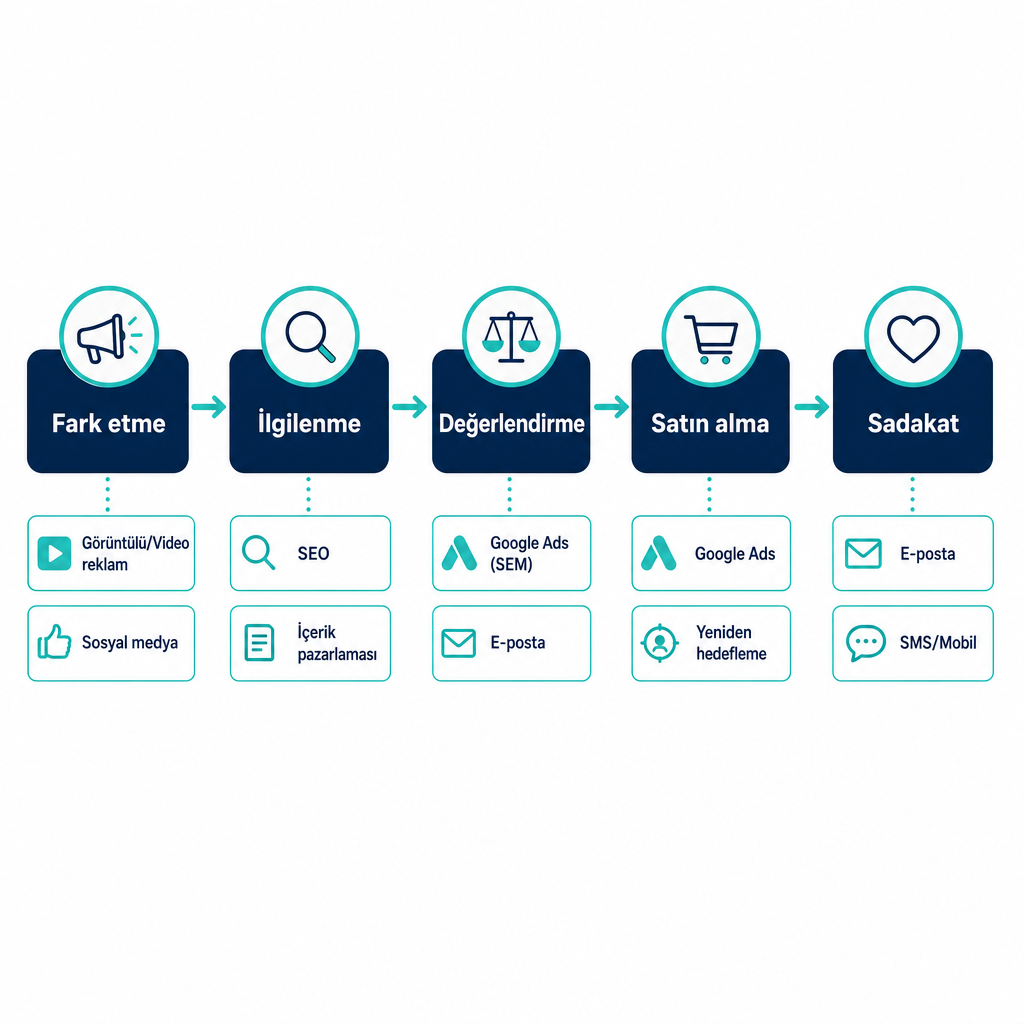
What decision are you actually making with digital marketing?
Behind the question "What is digital marketing?" lies a practical decision: Which digital channels, with which goals, and with which priority will you invest in to grow your business? You can simplify this decision by breaking it into four questions.
Which goal will you focus on? Brand awareness, website traffic, leads, or direct sales? Channels have different strengths for different goals; that's why choosing a channel without defining the goal often turns into a waste of budget.
Which audience do you want to reach? Digital channels offer detailed targeting based on demographic information, interests, behaviors, and search intent. Often a narrow but highly relevant audience is more profitable than a broad and irrelevant one.
Which channel will you start with? Instead of loading up on every channel at once with a limited budget, prioritize according to your business type. For e-commerce, search engine advertising and SEO are usually the priority; for a content-focused education brand, a combination of SEO, content, and email may make more sense.
How will you measure? You should track the success of each campaign with predefined metrics. In a traffic-focused campaign, click-through rate (CTR) and session count; in a sales-focused campaign, conversion rate and cost per acquisition; in a brand campaign, reach and engagement stand out. For quick pointers on which metric to look at, our practical tips section makes your job easier at decision moments.
These four decisions are the fundamental mechanism that moves your digital marketing efforts from random experiments to a systematic, learning, and continuously improving structure.
The most common mistakes beginners make
When set up correctly, digital marketing is a scalable growth engine; however, a few recurring mistakes at the start directly affect the outcome.
- Focusing on the channel and forgetting the goal. "We should be on Instagram" is not a strategy on its own. If the goal, audience, and message are not clear, the budget goes to waste regardless of the channel.
- Spending without measuring. Launching a campaign without defining tracking codes, analytics tools, and basic KPIs means spending money without knowing what works; this makes optimization impossible.
- Addressing the wrong audience. Overly broad or irrelevant audiences can inflate top metrics such as clicks and impressions, but they may not produce results on the sales side.
- Looking only at the short term. Working only on a campaign basis and neglecting long-term areas such as SEO and organic content makes sustainable growth difficult.
- Reading data out of context. Interpretations such as automatically treating a high click-through rate as success lead to wrong decisions.
The way to reduce these risks is to learn the basic concepts, test with small budgets, learn to make sense of data, and regularly keep your knowledge up to date with reliable sources.
A practical example for an e-commerce store in Turkey
Suppose you run a newly opened e-commerce store in Turkey and your goal is to reach a certain number of sales per month and increase your conversion rate. In this case, a typical digital marketing setup might work as follows, to illustrate the logic of the process.
With SEO, you start gaining organic visibility for users searching for your product categories and brand; this creates a continuous source of traffic in the medium to long term. On the Google Ads side, you focus on keywords with high purchase intent (for example, "buy X brand shoes" or "Y model discounted"), and you measure the traffic coming from there on a campaign basis. On Instagram and TikTok, you build brand awareness and social proof with product-focused short videos and influencer collaborations. With email and SMS, you aim to increase the conversion rate by setting up reminders and campaign flows for those who abandon their carts.
Throughout this process, tracking traffic sources, product page conversion rates, cart abandonment rate, and return on ad spend (ROAS) supports your decisions with data. If you want to address the conversion side in more depth, our guide to increasing e-commerce conversion rates expands this example with concrete steps.
How do you combine learning and practice with Digigund?
Beginners in digital marketing struggle to choose where to start due to the confusion of concepts and the abundance of resources. At Digigund, we aim to solve this problem with an education-focused learning flow tailored to the Turkish market.
Our glossary section clarifies concepts such as SEO, Google Ads, conversion rate, and ROAS by explaining digital marketing terms in Turkish and in an understandable way. Our practical tips content guides you at decision moments such as which metric to look at, which mistakes to avoid, and what to pay attention to in advertising. Our free digital marketing tools section gathers in one place the essential tools you can use when setting up campaigns and measuring performance. Our news section, where we follow the current digital marketing agenda, makes it easier for you to keep track of developments in areas such as Google Ads, SEO, and analytics, and to update your strategy according to changing dynamics.
This structure supports beginners in building the conceptual foundation correctly and learning to think in a KPI-focused way in practice. If you haven't yet clarified where to start, we can determine your business model and priority and plan the channel and metric combination suitable for you together.
Frequently Asked Questions
Where should I start with digital marketing?
First clarify your goal (sales, leads, awareness) and your target audience; then choose a main channel according to your business model (for example, SEO and Google Ads for e-commerce; SEO, content, and email for content-focused businesses) and proceed by testing with small budgets.
Which is better, digital marketing or traditional marketing?
It depends on the type of business; however, thanks to its measurability and targetability, digital marketing offers a more flexible and optimizable structure for most businesses.
Is a large budget absolutely necessary for digital marketing?
No. SEO and content marketing in particular are time- and effort-focused; by testing with small ad budgets, you can see which campaigns work and grow gradually.
How do I measure success in digital marketing?
First define your goal, then choose metrics appropriate to that goal: conversion rate and cost per acquisition for sales, sessions and click-through rate for traffic, reach and engagement for brand, and so on.
Which skills are important for learning digital marketing?
Data literacy, basic analytics, content creation, practical knowledge of using advertising platforms, and customer-focused thinking are the skills that will serve you best in the long run.