Practical Guides
Log in to saveWhat Is Digital Marketing? A Guide for Beginners
11 min read

The shortest answer to the question of what digital marketing is, is this: it is the entirety of marketing activities carried out through electronic devices and the internet, across digital channels such as search engines, websites, social media, email, and mobile applications; delivering products, services, and brands to the target audience, while also being measurable and data-driven. In other words, it is not just a single channel, but a system formed by mutually reinforcing channels and data.
This approach differs from traditional marketing in two fundamental ways. First, it allows you to track the path a message takes from end to end: every step can be recorded, from a person seeing an advertisement to visiting your site, adding a product to the cart, and making a purchase. Second is scalability; you can start with a small budget and grow it by seeing what works. At digigund, we prepared this guide to explain the concepts at a beginner level but with technical accuracy; our goal is to provide you with an actionable mental map.
Table of contents
- What is digital marketing and how does it work?
- The main types and channels of digital marketing
- Why is it important for beginners?
- Common misconceptions and facts
- What to consider when starting out?
- Frequently Asked Questions
What is digital marketing and how does it work?
Digital marketing, in its broadest definition, encompasses all marketing efforts that use an electronic device or the internet. The promotion of products and services in the online environment is at the center of this definition. However, reducing the subject to the level of "advertising on the internet" would be misleading; the mechanism underlying its operation is more layered.
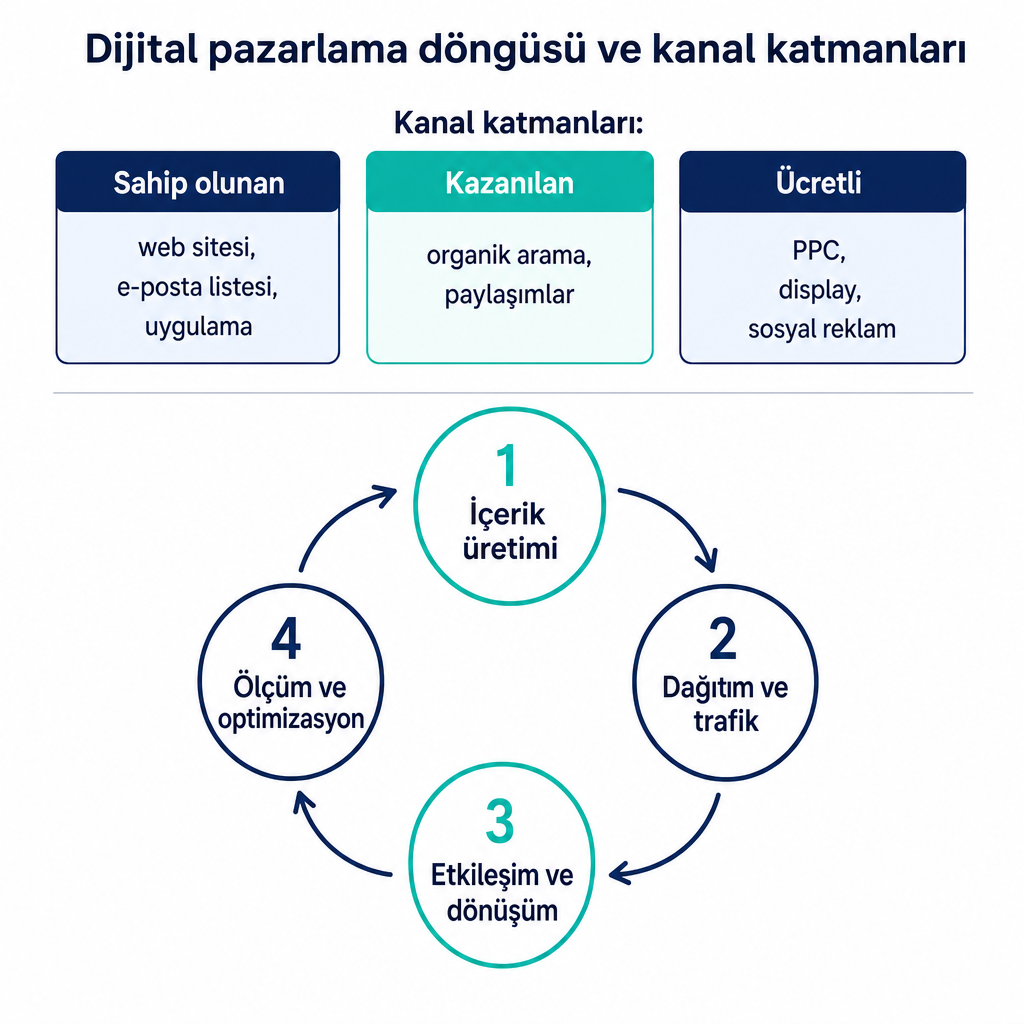
At its core, there are two movements: the production and distribution of content, and the strategic promotion of this content through the right channels. On one side, there are environments where content lives, such as websites, landing pages, social media profiles, email newsletters, and mobile applications. On the other side, there are promotion mechanisms that make this content visible: channels such as search engine optimization (SEO), search engine marketing (SEM), pay-per-click (PPC) advertising, content partnerships, social media, email, and SMS. Dividing these channels into three groups—owned, earned, and paid—often makes it easier to understand which one plays which role.
The actual functioning emerges in the following cycle. First, a piece of content or an offer is produced. This content is distributed across relevant channels and attracts traffic. Interaction is established with the visitor; some examine the product, some fill out a form, some make a purchase. Data is collected at every stage. This is where the point that distinguishes digital marketing from other approaches comes into play: by analyzing the performance of campaigns and content, it is understood what works and what does not, and this analysis is often done in real time. This measurement and optimization cycle turns digital marketing into a continuously learning system rather than a static advertisement.
This is exactly why we at digigund place special importance on the topics of measurement and analytics. You cannot manage or improve an activity you cannot measure. Even at a beginner level, knowing which metric tells you what enables you to direct your budget and time to the right place.
The main types and channels of digital marketing
While it is correct to think of digital marketing as a single whole, recognizing its subtypes allows you to see which tool does which job. The distinctions below provide a beginner-level map; each is a field of expertise that deepens on its own.
Search engine–focused marketing. It aims to make your brand discoverable there when users come to a search engine with a need or question. The organic side of this is SEO: technical and content work that ensures your content appears in the free rankings of search results. The paid side is SEM and search advertising; you purchase visibility for specific queries.
Paid advertising. Pay-per-click (PPC) campaigns, visual display ads, and video ads fall into this group. Their common feature is that you allocate a budget in exchange for visibility or engagement. When set up correctly, it allows for quick testing and targeting specific audiences.
Social media marketing. It has both organic and paid dimensions. Its organic side is built on community building, regular content, and engagement. Its paid side enables reaching broader or more targeted audiences through the advertising systems of social platforms.
Email marketing and automation. It works on the basis of permission-based messaging. By segmenting lists, automated flows triggered according to user behavior (for example, a welcome series or an abandoned cart reminder) can be set up. Being an owned channel makes it valuable in terms of cost and continuity.
Content marketing. It aims to provide value to your target audience and build trust through formats such as blog posts, guides, videos, and infographics. Content marketing is often the common ground that feeds SEO, social media, and email.
Beyond these types, the scope of digital marketing also includes technologies applied to online channels such as the web, email, databases, mobile and wireless devices, and even digital TV. In other words, the word "digital" encompasses not only social networks but all touchpoints involving a screen and connectivity. While it is useful to learn the types separately, the real value emerges at the point where they feed each other: search traffic grows your email list, email triggers social engagement, and content fuels all of them.
Why is it important for beginners?
The value of digital marketing for a beginner-level reader comes not from being an abstract trend, but from solving concrete problems. It is possible to understand this value through three fundamental characteristics.
The first is measurability. In traditional marketing, it is often difficult to know clearly how many sales an advertisement converts into. In digital, however, you can track activities from end to end and see which channel brought which result. This is the key to using a limited budget efficiently.
The second is targeting and personalization. Signals such as interests, behavior, and platform habits make it possible to deliver the right message to the right person. Instead of giving everyone the same message, you can approach different audiences with different content.
The third is the low barrier to entry. As the E-Commerce Academy, a public resource, also emphasizes, digital marketing is defined in the context of e-commerce as the art of allocating resources such as time and money in a planned manner to achieve online sales goals. This means you can get started even without large initial capital. This accessibility is especially decisive for small businesses and startups.
Where you position yourself also changes what digital marketing means to you. If you are a student or a new marketer, the priority is to solidly learn the concepts and the mechanism. If you are an e-commerce site manager, optimizing the relationship between traffic and conversion comes to the center. If you are a performance marketing practitioner, reading cross-channel data and shifting the budget to the most efficient place stands out. The same discipline produces different priorities for different goals.
When we prepared this guide at digigund, we took precisely these different starting points into account. Our glossary and practical guides are designed to clear up conceptual confusion and to allow each reader to progress from their own level.
Common misconceptions and facts
The points where beginner-level readers most often get stuck usually stem from incomplete or distorted definitions. Correcting these misperceptions is the first step in building a correct mental model.
Wrong: Digital marketing is only social media. While social media is a powerful component, it does not represent the entire definition. There is a much broader set of channels involved, including search engines, websites, email, mobile channels, and digital TV. Focusing on only a single platform means missing a large part of the picture.
Wrong: Advertising alone is sufficient. Advertising only buys visibility; however, this visibility does not turn into results without the content the visitor encounters, the user experience, search visibility, and brand positioning. Authoritative sources define digital marketing as a holistic system that includes content production, distribution, and strategic promotion together. Advertising is a part of this system, not the whole.
Wrong: Digital marketing is only for big brands. Public resources and chambers of commerce position digital marketing as a fundamental tool even for SMEs. Its accessible barrier to entry and measurable structure make it especially valuable for small-scale businesses.
Wrong: There is no need to deal with data and measurement. The distinguishing feature of digital marketing is that it allows you to understand what works by analyzing campaigns and content. If you skip measurement, you end up running digital marketing "blindly" like traditional marketing, and you give up its greatest advantage.
The common denominator of these misperceptions is reducing digital marketing to a single tactic. Yet the discipline is a multi-channel and data-driven whole; its parts gain meaning together, not separately.
What to consider when starting out?
This section does not give you a step-by-step setup recipe; instead, it provides you with criteria you can use when making decisions. For practical details, the "how-to"–focused guides we will publish in the coming period will be a more suitable foundation.
Clarify your goal. Digital marketing can be used both for brand awareness and for final sales. Do you want brand awareness, web traffic, collecting potential customers (leads), direct sales, or repeat purchases? Each goal brings different channels and different success metrics to the forefront. A study with an unclear goal is a study that cannot be measured or directed.
Remember that channels work together. The most common trap beginners fall into is fixating on a single channel. However, your website, search engines, social media, and email take on mutually reinforcing roles. When making decisions, think not about a single channel, but about how these will connect to each other.
Evaluate your resources realistically. Digital marketing is defined, even in e-commerce, as the art of allocating resources such as time and money in a planned manner. Therefore, when choosing a channel, consider not only the technical requirements but also your content production capacity, the time you can devote to operations, and the learning curve of each channel. A plan you cannot sustain is worse than the best plan.
Establish a measurement culture from the start. Setting measurable goals from the beginning allows you to know what to improve as you progress. Determining which metric aligns with your goal is a choice that should be made from the very beginning, not afterward.
Align with your business goals. Digital marketing activities are not an end in themselves; they should serve your general business goals such as geographic expansion, reaching new customer segments, repeat purchases, or subscriptions. The fact that a channel is "popular" does not mean it is right for your business.
After evaluating these criteria, the following question naturally arises: Which channel should I prioritize and where will I learn its practice? At this point, advancing your learning journey in layers is the most efficient way. First, establish the basic concepts in this hub guide; then deepen your knowledge with our dedicated guides on topics such as SEO, Google Ads, e-commerce marketing, and measurement/analytics. Using the glossary, KPI, and tips guides at digigund along with the free tools, you can build your own learning map according to your own goals.
Frequently Asked Questions
What is the difference between digital marketing and traditional marketing?
The fundamental difference emerges in the channel and in measurement. While traditional marketing uses offline media such as newspapers, television, or billboards, digital marketing operates through the internet and electronic devices. The more decisive difference is measurability: in digital, you can track a person's journey from seeing an advertisement to making a purchase, and improve campaigns by analyzing them in real time.
Does digital marketing only mean social media?
No. While social media is an important component, it does not cover the entire definition. Digital marketing encompasses a broad set of channels, including search engines, websites, email, mobile applications, and digital TV. It is a data-driven and multi-layered system that uses these channels together.
Is digital marketing necessary for a small business?
Yes. Public resources and chambers of commerce position digital marketing as a fundamental tool even for SMEs. Its low barrier to entry, measurable structure, and targeting capabilities make it possible for small businesses working with limited budgets to benefit from digital marketing.
Which type of digital marketing should I start with?
This guide does not recommend a specific channel; because the right starting point depends on your goal, your target audience, and your resources. First, clarify what you want to achieve (awareness, traffic, leads, or sales); then set priorities by understanding how channels work with each other. For application details, our topic-specific guides offer a more suitable starting point.
Why are data and measurement so important in digital marketing?
Because the greatest advantage of digital marketing is that you can see what works and what does not. If you skip measurement, you cannot know where you should spend your budget and time, and you cannot improve your work. Setting measurable goals from the start turns digital marketing into a continuously learning system.